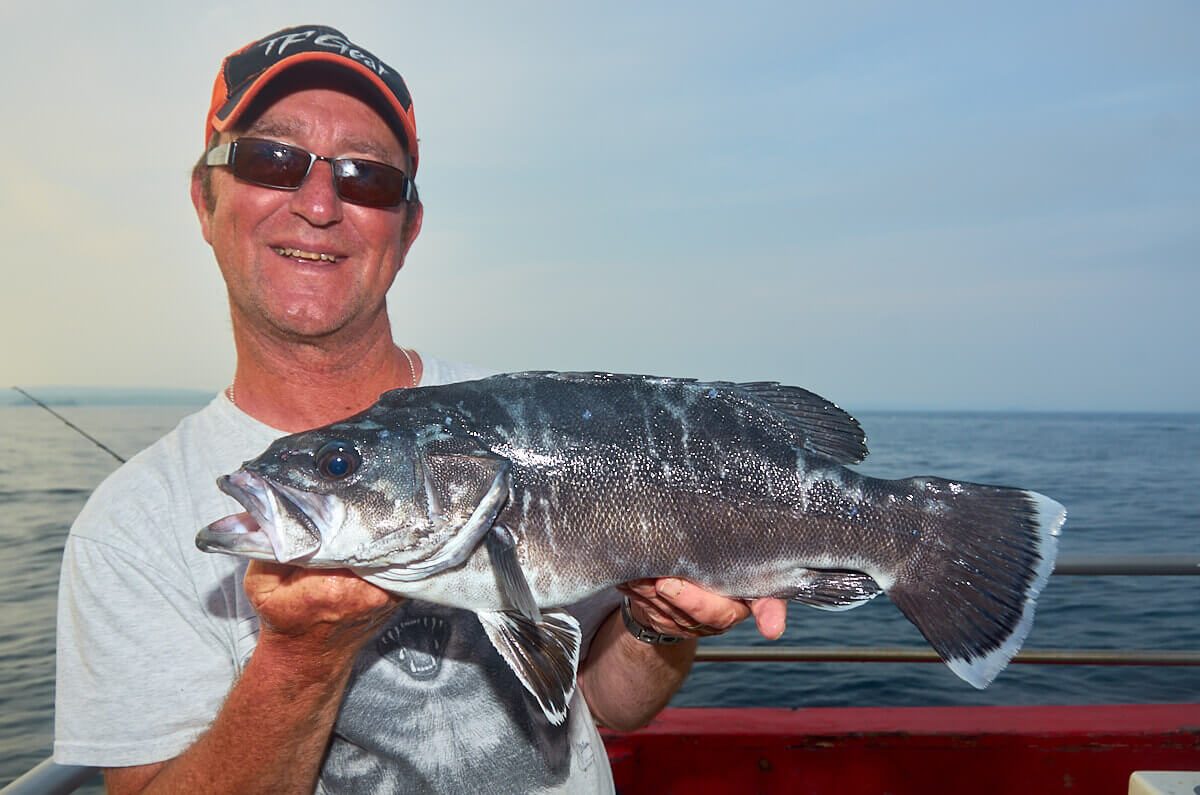
The wreckfish — or stone bass — is a large, deep-water grouper relative that lives in the darkest recesses of caves, wrecks and deep underwater cliff systems, and is one of the most impressively powerful and least commonly caught large fish on the British and Irish angling list. This guide looks at the species itself.
Identification
The wreckfish is a very large, deep-bodied, heavily built fish with a large head, wide mouth and the characteristic bony strut running horizontally across the gill cover, terminating in a spine. The pre-operculum has a spiny margin. The body is covered in small, rough scales. Colouring is dark brownish-grey to bluish-grey with darker spots in juveniles.
Distribution
Found in the Atlantic from Iceland south to South Africa and into the Mediterranean, with a disjunct distribution in the Indo-Pacific. Around the British Isles it is most associated with deep, offshore rocky ground in the south and west.
Habitat
Deep rocky ground, caves, wrecks and cliff faces from around 40 m to over 600 m. Juveniles have a pelagic phase, often associated with floating objects at the surface — the “wreckfish” name reflects juveniles sheltering under floating wreckage. Adults settle to the deep rocky bottom.
Diet
Large fish, cephalopods and crustaceans.
History
The wreckfish has a small but dedicated following among British and Irish deep-water anglers fishing the shelf edge and deep offshore marks, where it is a prized and powerful catch. It is commercially fished in the Azores and the south Atlantic.
Interesting Facts
Juvenile wreckfish are semi-pelagic and have been recorded sheltering under floating debris far out at sea — a habit that presumably helps the tiny young fish survive in the open ocean before settling to the bottom habitat they occupy as adults.
The Data Deficient IUCN status reflects insufficient population data; the species is commercially exploited in some parts of its range.
A deep-water prize — see our deep-water boat fishing features for more.