The ballan wrasse is the largest and most commonly targeted wrasse in British and Irish coastal waters — a powerfully built, rocky-ground predator that dives into crevices when hooked and provides surprisingly strong sport, and is one of the most recognisable fish of shallow western reefs. This guide looks at the species itself.
Identification
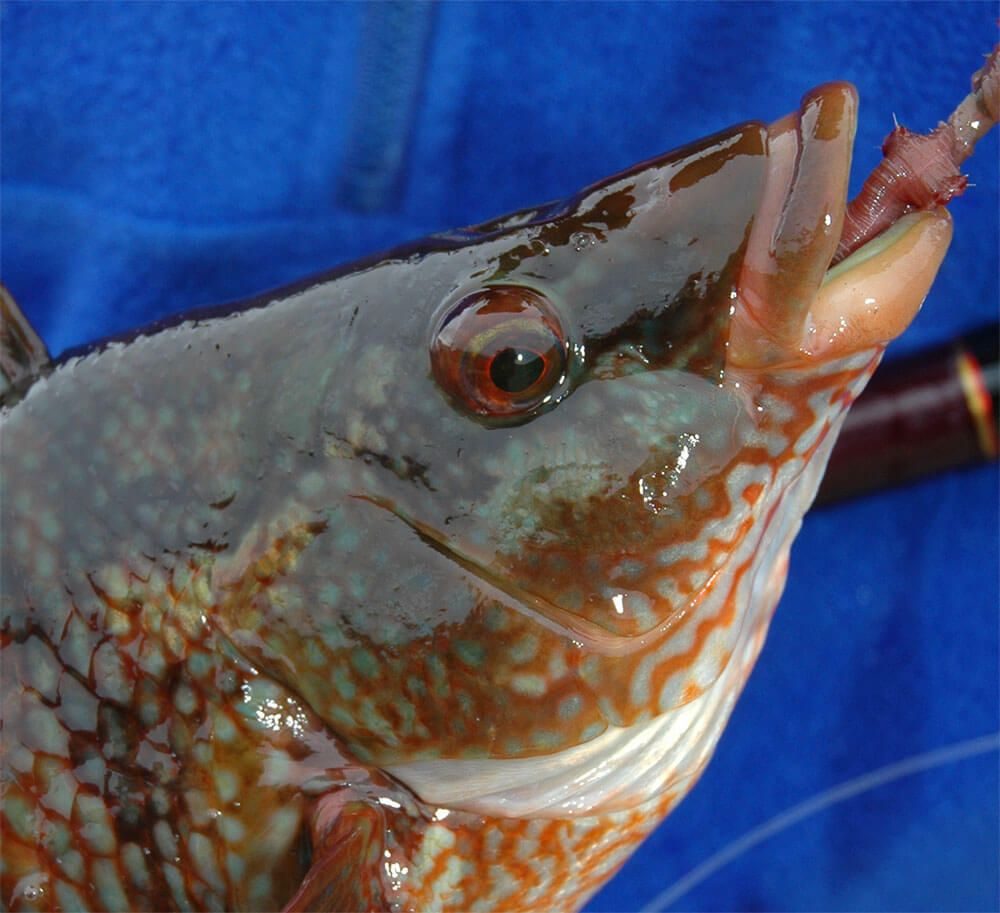
The ballan wrasse has a deep, laterally compressed body with a single continuous dorsal fin, thick fleshy lips and prominent teeth. It shows extraordinary colour variation — from plain brown through vivid greens and oranges to dark purple, often with white spots or reticulations. Juveniles are bright green. The wide variation can confuse the inexperienced observer, but the overall body shape, thick lips and rocky-ground habitat are consistent.
The largest British wrasse and readily identified by size alone once over 35 cm.
Distribution
Found in the eastern Atlantic from Norway south to Morocco and into the Mediterranean. Around the British Isles it is most common on the rocky western and southern coasts — Cornwall, Devon, West Wales, western Scotland and all around Ireland.
Habitat
Rocky reefs, boulder ground and kelp beds from the intertidal zone to around 50 m. Strongly associated with structured rocky ground and kelp.
Diet
Mussels, barnacles, sea urchins, small crabs and other hard-shelled invertebrates, crushed by powerful pharyngeal teeth.
History
The ballan wrasse has been a recreational angling target on rocky western shores for generations. It is also commercially caught in Norway, Scandinavia and Scotland as a “cleaner fish” for salmon aquaculture — wrasse pick sea lice off salmon in fish farm cages.
Interesting Facts
All ballan wrasse begin life as females; the largest, dominant fish subsequently change sex to become males. This protogynous hermaphroditism means that large fish at the top of the local population are almost always male.
For rocky ground tactics and bait, see our How to Catch Wrasse guide.