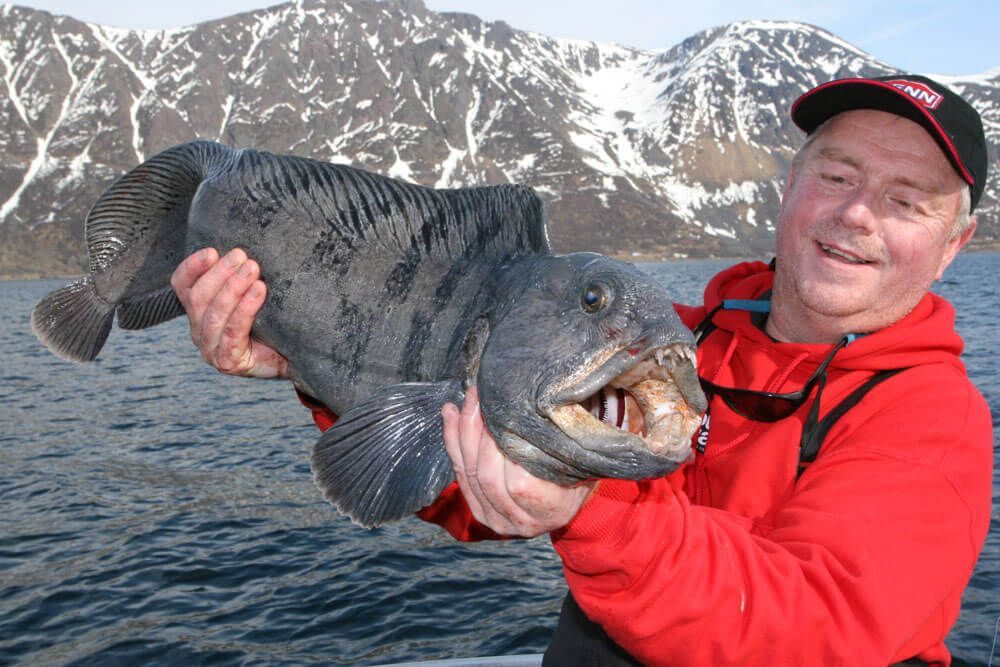
The wolffish is one of the most formidable-looking fish in British and Irish waters — a large, powerfully built, eel-like predator of deep northern rocky ground, armed with an extraordinary set of large, protruding fangs at the front of the jaw and massive crushing teeth in the rear. This guide looks at the species itself.
Identification
The wolffish has a large, heavy head with a rounded snout and massive jaws bearing four to six large conical fangs at the front, behind which are strong crushing teeth in rows. The body is long, eel-like and muscular with a single dorsal fin running the full body length to the tail. The anal fin is also long. There are no pelvic fins.
Colouring is slate-grey to brownish-grey with darker bars and blotches. Impossible to confuse with anything else in British waters.
Distribution
Found throughout the North Atlantic from the Barents Sea south to the British Isles, Iceland, Greenland and across to the western Atlantic. Around the British Isles it is a deep northern species, most common off Scotland, Shetland and in deep western waters.
Habitat
Rocky, hard ground in deep cold water from around 20 m to over 600 m. Inhabits crevices and holes in rocky reef.
Diet
Hard-shelled prey — sea urchins, starfish, large crustaceans, mussels and other molluscs — crushed by the powerful rear teeth. The wolffish is one of the few large British fish capable of feeding regularly on sea urchins.
History
Wolffish are caught commercially, particularly by Norwegian and Icelandic fisheries, and the white, firm flesh is excellent quality. They are occasionally taken by British deep-water boat anglers working northern and western marks. The species is considered a potential aquaculture candidate for cold-water fish farming in Scandinavia.
Interesting Facts
The wolffish is one of very few marine fish that actively guards its eggs — both parents remain near the nest of eggs through the winter incubation period, fanning them and guarding against disturbance.
The massive teeth are not for tearing prey but exclusively for crushing — sea urchins and shells. The front fangs seize and hold prey while the rear teeth do the work.
See our deep-water and northern boat fishing features for more.