The whiting is one of the most familiar fish to the UK and Irish shore angler, the dependable winter species that keeps rod tips rattling on cold nights when little else is feeding. It rarely grows large, but it is widespread, willing and surprisingly good on the plate. This guide looks at the whiting as a species in its own right.
Identification
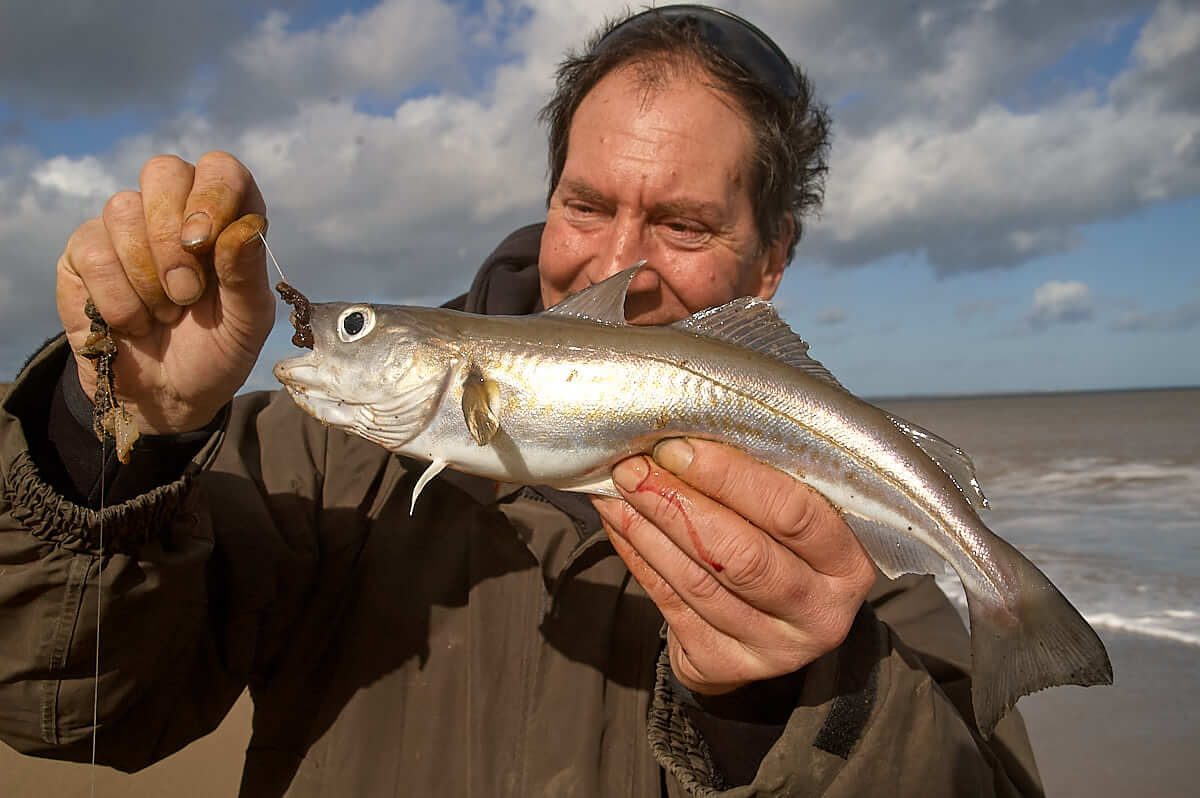
The whiting is a slim, elegant fish with a narrow, pointed head and snout – a more delicate outline than the heavy-headed cod. The upper jaw is slightly longer than the lower, and unlike most of its relatives the adult whiting carries no chin barbel, though tiny juveniles may show a minute one.
It has three dorsal fins and two anal fins, and a body that is silvery and lightly built. Colour ranges from yellowish-brown to blue-green or grey on the back, with yellowish-grey flanks and a white, silvery belly.
The key identifying feature is a small dark blotch at the upper base of each pectoral fin. That mark, together with the pointed head and absent barbel, separates whiting from a small cod at a glance.
Distribution
Whiting are native to the north-eastern Atlantic, ranging from the south-eastern Barents Sea and Iceland down to Portugal, and into the Black Sea, Aegean and Adriatic. They are rare in the north-western Mediterranean.
They are abundant and widespread right around the British Isles and Ireland, found from shallow coastal waters out to the offshore grounds. For most anglers they are a year-round presence inshore that builds to a peak in the colder months.
Habitat
Whiting are most commonly found between about 30 m and 100 m, though they range from around 10 m down to 200 m. They favour mud and gravel seabeds but also hold over sand and rock.
The fish move inshore in numbers through autumn and winter, which is when they become a mainstay of beach and pier fishing. Whiting only really move to the open sea after their first year of life; juveniles spend their early months in shallow water.
Diet
The whiting is a voracious little predator, far more aggressive than its size suggests. Younger fish feed on small crustaceans – shrimps, crabs and the like – along with worms, molluscs and cephalopods.
As they grow, the diet shifts firmly towards fish, and whiting hunt sprat, herring, sandeel and other small species with real appetite. They are also cannibalistic, readily eating their own smaller offspring. This fish-eating habit is why a strip of mackerel or a fish bait works so well for them.
History
Whiting has long been a cheap and plentiful food fish in Britain and across Europe – historically a staple for poorer households, and at various times used for pet food and even as a filler. Its flesh is soft, white and easily digested, which made it a traditional choice for invalids and children.
Commercially it remains important across the north-east Atlantic, and because juveniles are so easily caught in nets, fisheries managers have at times introduced measures – seasonal closures and reduced fishing effort – to protect spawning fish and cut the capture of small ones. Despite heavy fishing pressure, the species is widespread and abundant enough to be assessed as Least Concern.
Interesting Facts
Very small whiting, under about 5 cm, have a remarkable habit of sheltering among the stinging tentacles of live jellyfish, using them as a mobile refuge from predators.
Whiting breed across a long window from January to July in UK and Irish waters, with the eggs drifting freely in the water as plankton.
Despite topping out at only a few pounds, the species can live for up to twenty years, and FishBase records the largest reliably measured fish at over 90 cm – far beyond anything an angler is ever likely to meet.
The name “whiting” has since been borrowed for all sorts of unrelated fish around the world, but the original merling of European waters is the true whiting.
For the best baits, rigs and winter tactics, see our full How to Catch Whiting guide.