The turbot is the king of the British flatfish — the largest, most powerfully built and most prized of all the flatfish encountered in British and Irish coastal waters. Supreme at the table and a formidable opponent on suitable tackle, the turbot occupies the top of the flatfish hierarchy in terms of angling achievement and commercial value. This guide looks at the species itself.
Identification
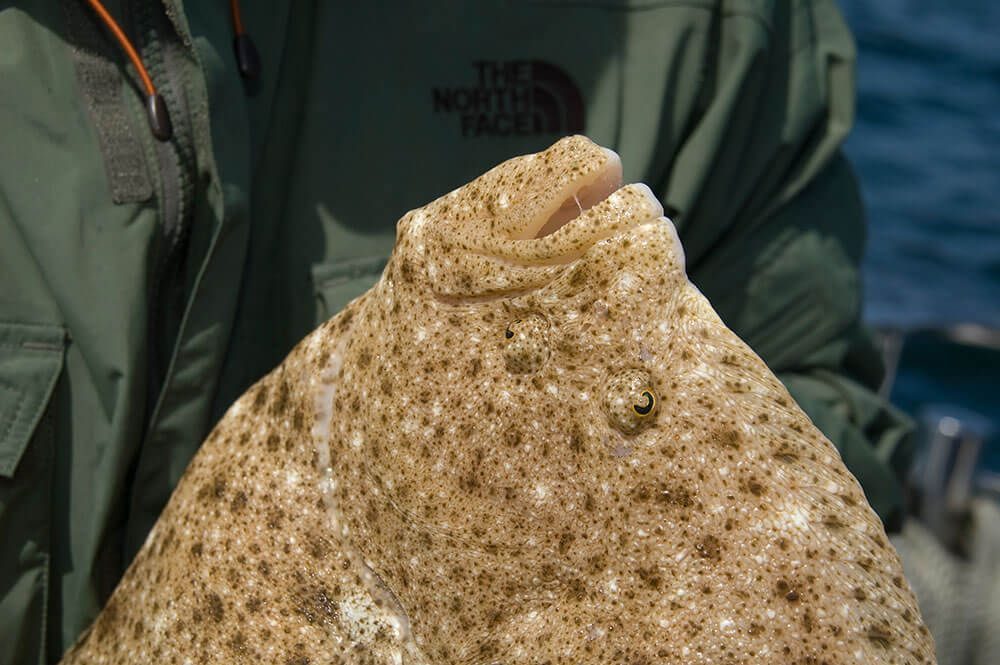
The turbot is a left-eyed flatfish with a broadly circular, very deep body — the broadest and most disc-like of all British flatfish. The skin lacks scales but is covered with numerous small bony tubercles on the upper surface. The lateral line has a pronounced arch over the pectoral fin. The dorsal fin begins in front of the eyes.
Colouring is variable but typically a warm sandy brown to greyish-brown with darker spots and blotches, providing camouflage against coarse sand and gravel. The underside is white.
Identified from the brill (the other large left-eyed flatfish) by being more circular, lacking the frilled front dorsal fin rays of the brill, and by having bony tubercles rather than smooth skin.
Distribution
Found in the eastern Atlantic from the White Sea and Norway south to the Mediterranean and the Black Sea. Around the British Isles it is found on all coasts with suitable sandy and mixed ground, most common in the south, east and the northern North Sea.
Habitat
Sandy and sandy-gravel seabed from the shoreline to around 80 m, most commonly between 20 m and 70 m. Prefers firm, coarse ground — the interface between clean sand and broken ground is a classic turbot mark.
Diet
Actively predatory on fish — particularly sandeels, sprat, small flatfish and other fish — as well as crustaceans. The turbot is one of the most actively predatory of all flatfish, ambushing prey from the bottom.
History
The turbot has been one of the most prized food fish in Europe since antiquity — both the Romans and the Victorians regarded it as the finest of all flatfish, worthy of special dishes and considerable expense. The finest specimens command premium prices in today’s fish markets.
Interesting Facts
The turbot’s patterning is specific to the individual fish and can provide natural identification for tagged or photographed specimens — each turbot has a unique spot pattern.
Turbot are farmed extensively in Europe, particularly in Norway, France and Spain, to supply the seafood market without further pressure on wild stocks.
For the best marks, rigs and seasonal timing, see our How to Catch Turbot guide.