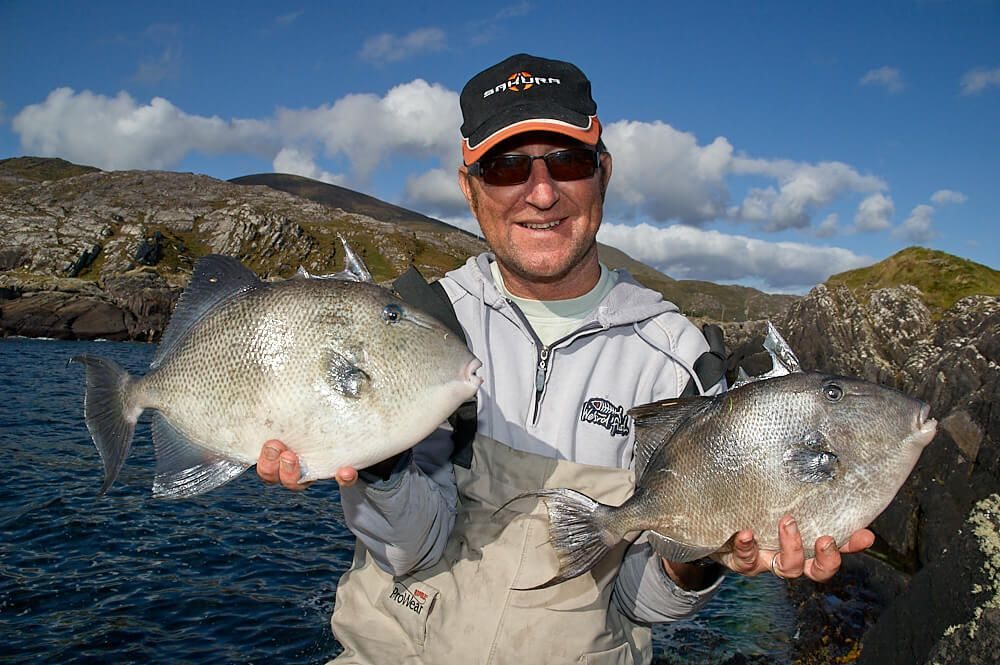
The grey triggerfish is a warm-water visitor from the open Atlantic that appears in British and Irish coastal waters in late summer — a deep-bodied, powerfully built fish with a remarkable locking dorsal spine mechanism and the ability to crunch molluscs and sea urchins with its strong, sharp teeth. This guide looks at the species itself.
Identification
The grey triggerfish has a very deep, laterally compressed body that is roughly oval and high-backed. The skin is thick and leathery with small, rough scales. The first dorsal fin has three strong spines — the first is very long and can be locked erect by the second “trigger” spine. The eyes are set very high and far back on the head. Colouring is pale grey to olive-grey with a bluish tinge and indistinct greenish markings.
The locked first dorsal spine is the defining feature of the triggerfish family — it cannot be depressed unless the second spine is pressed, which acts as a release trigger.
Distribution
Found in the Atlantic from Scotland south to Argentina, and in the Mediterranean. Around the British Isles it is a warm-water summer and autumn visitor, most commonly in the south and south-west.
Habitat
Coastal and offshore, associated with hard structure — reefs, wrecks, floating objects — from shallow water to around 100 m.
Diet
Molluscs, sea urchins, crustaceans and other hard-shelled prey. The strong beak-like teeth can crush sea urchin shells and thick-shelled molluscs.
History
The triggerfish has no established angling tradition in Britain but is an increasingly regular summer catch from south-western boat marks and occasionally from piers and rocks. Numbers in British waters appear to be increasing, possibly related to warming sea temperatures.
Interesting Facts
The locking spine mechanism is a defence against predators — when the triggerfish retreats into a crevice and erects its dorsal spine, it becomes extremely difficult to extract.
Triggerfish actively bite in defence when handled and can inflict a serious wound with the sharp incisor-like teeth.
See our species-hunting and boat fishing features for more on the warm-water visitors to south-western British waters.