The tope is one of the most important and most endangered sharks in British and Irish coastal waters — a powerful, fast, long-distance migrating houndshark that is a cornerstone of British offshore shark angling and a species whose global population has collapsed by an estimated 88% over three generations. This guide looks at the species itself.
Identification
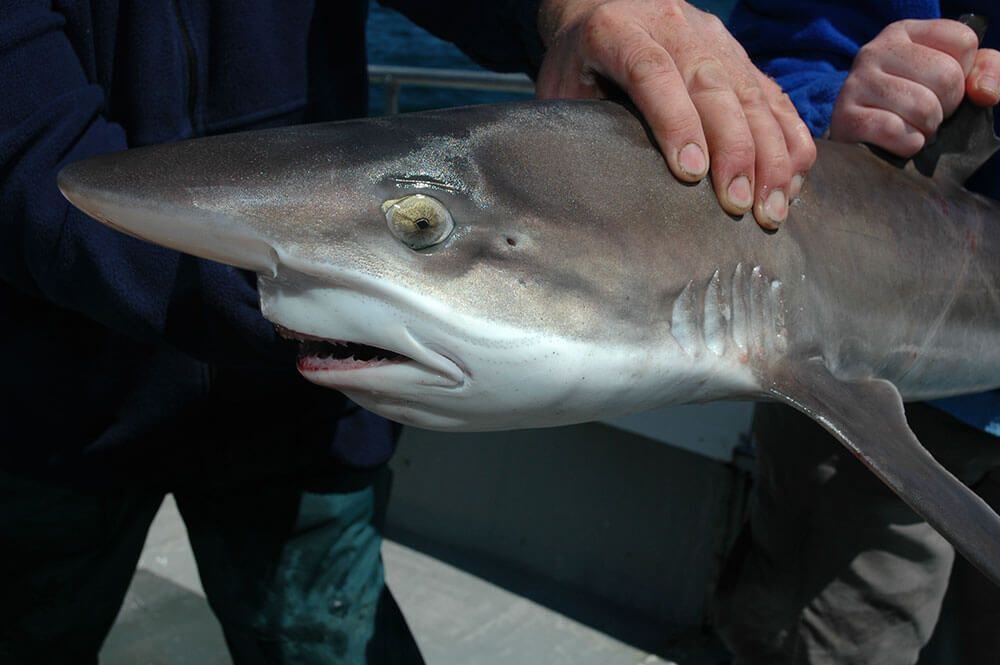
The tope is a slender, streamlined houndshark with a moderately long, pointed snout, large eyes and two dorsal fins. It has the classic grey shark colouring — grey above, white below — with a broad, slightly asymmetric tail and relatively long pectoral fins. No spines on the dorsal fins.
Distinguished from the smoothhound by its larger size, more pointed snout, and notably the second dorsal fin is placed above the anal fin (further forward in smoothhounds).
Distribution
Found in temperate waters across most of the world’s oceans. Around the British Isles it is a summer visitor to all coasts, appearing inshore from spring through autumn and most abundant in the Channel, Irish Sea, western approaches and off Wales and Scotland.
Habitat
A pelagic and demersal species found from the shoreline to around 550 m, often in schools segregated by sex and size. Pregnant females come very close inshore, including into estuaries, to pup in shallow nursery areas.
Diet
Fish — primarily bottom fish like whiting, flatfish and dogfish — taken both at the bottom and in midwater.
History
The tope has been central to British sea angling for over half a century. It fights powerfully and runs hard on light tackle, making it one of the most sporting of British inshore sharks.
Globally, populations have declined by an estimated 88% over 79 years from commercial exploitation for fins, liver oil and meat. In the UK the tope is now a strongly encouraged catch-and-release species.
Interesting Facts
Tope are viviparous and produce small litters (6–52 pups) after a 12-month gestation. They are extremely long-lived — females can reach 55 years — and slow to mature (females at 10–13 years), making them catastrophically vulnerable to fishing pressure.
Tagged tope have been tracked from British waters to West Africa and the Canary Islands — remarkable trans-Atlantic migrations for an inshore species.
Please practice catch-and-release for tope. For tackle and tactics, see our shark fishing features.