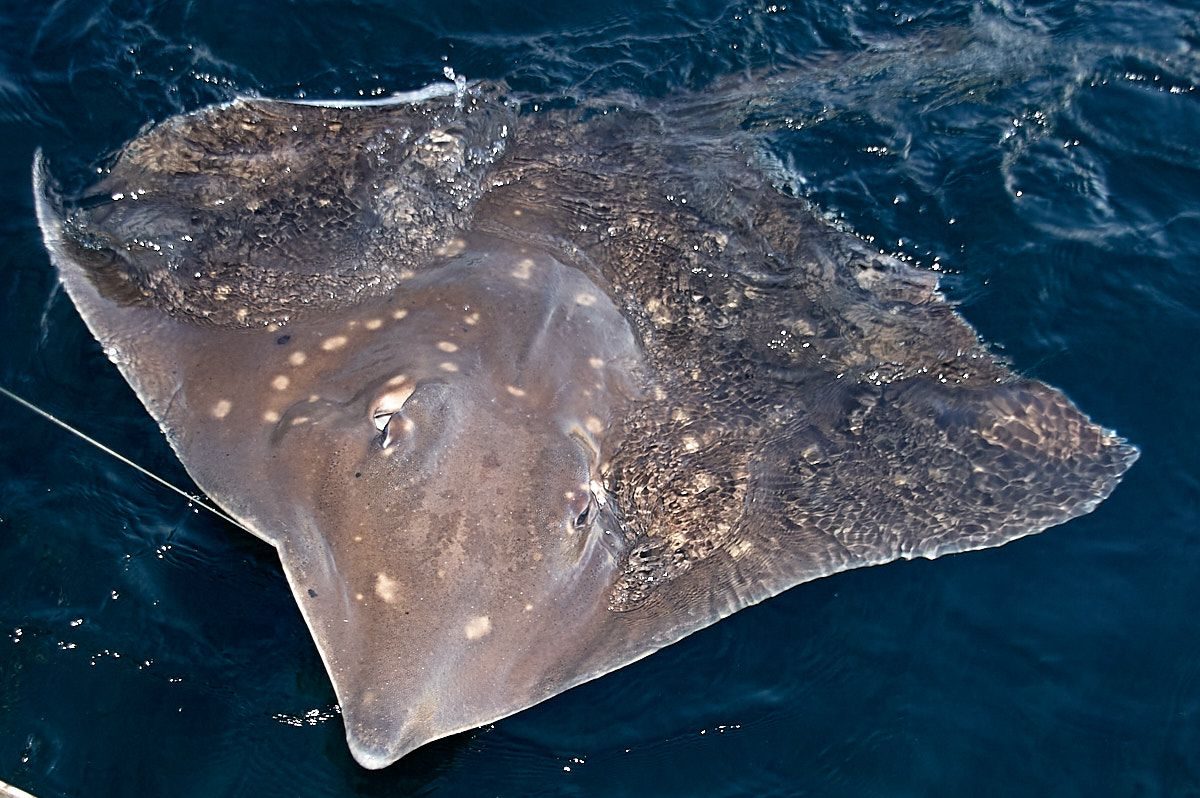
The common skate is the largest ray in the world — a massive, long-lived batoid of the northern and western grounds that has been brought to the brink of extinction across most of its former British and Irish range and is now a Critically Endangered, fully protected species. This guide looks at the species itself.
Identification
The common skate has a very large, rhomboid disc with a long, pointed snout. The upper surface is olive-brown to greyish-brown with variable spots and blotching. The underside is dark grey — darker than most other British rays — often with spots or marbling. Adults have two rows of thorns along the tail; juveniles have additional thorns near the eyes.
Note: what was historically called “common skate” has been split into two species since 2009: the blue skate (D. batis) and the larger flapper skate (D. intermedius). Both are Critically Endangered and both must be returned if caught.
Distribution
Historically found throughout the north-eastern Atlantic and Mediterranean. Now rare throughout most of its former range, with viable populations mainly off western Ireland and north-west Scotland.
Habitat
Sandy and muddy seabed from around 30 m to 600 m.
Diet
Fish, crustaceans and other bottom-living prey.
History
The common skate was once so abundant that it was sold in British fish markets and regularly caught by shore and boat anglers. Commercial trawling and bycatch mortality decimated populations through the 20th century. It was the first elasmobranch to be placed on the EU prohibited species list in 2009 — it may not be landed.
It is a prohibited species in UK waters: any common skate caught must be returned immediately with minimum handling.
Interesting Facts
The flapper skate (D. intermedius) is the largest skate species in the world. A fish of 3 m total length may be 50 or more years old. This extreme longevity and slow reproduction make it catastrophically vulnerable to even low levels of fishing mortality.
The Marine Conservation Zone at Loch Sunart in Scotland was partly designated to protect a key remaining flapper skate population.
A Critically Endangered prohibited species — must be returned immediately. Any sightings should be reported to the relevant recording project.