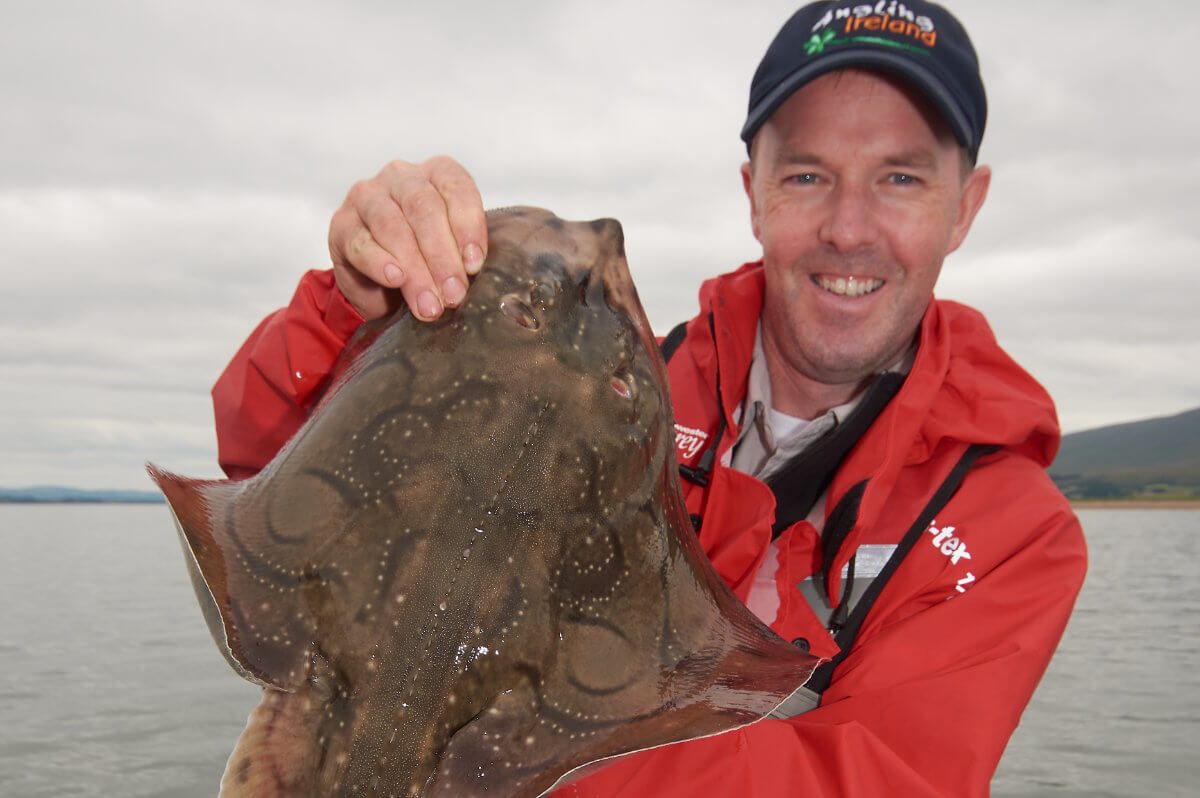
The undulate ray is one of the most beautifully marked rays in British and Irish waters — the distinctive bands and white spots of its upper disc are unlike any other British ray, making it immediately recognisable. It is also a species under serious conservation pressure. This guide looks at the species itself.
Identification
The undulate ray has a rhomboid disc with a fairly pointed snout. The upper surface is the key identification feature: a warm brownish background is overlaid with a pattern of dark, wavy or undulating bands across the wings (the “undulate” of the name), broken and dotted with white spots scattered among the bands. The overall effect is a bold, high-contrast pattern of dark bars and pale spots, quite different from the uniform spotting of the spotted ray or the plain colour of the thornback.
Distribution
Found in the eastern Atlantic from southern Ireland and England south to the Gulf of Guinea, and in the western Mediterranean. Around the British Isles it is most associated with the English Channel and the Bristol Channel — the south-western approaches are the main British grounds.
Habitat
Sandy and muddy seabed from around 50 m to 200 m, preferring shallower inshore grounds within this range.
Diet
Fish, flatfish, crustaceans and invertebrates.
History
The undulate ray is on the UK Biodiversity Action Plan list and is a Species of Principal Importance in England and Wales. It is a fully protected species in UK waters: any undulate ray caught must be returned immediately.
The split IUCN status — Endangered globally but Near Threatened in Europe — reflects the relatively better condition of the European Atlantic population compared to the overall global assessment.
Interesting Facts
The beautiful banding pattern that makes this species so recognisable is thought to function as disruptive camouflage against dappled sandy or shell-gravel seabed.
It is a Species of Principal Importance and a legally protected fish in UK waters — do not retain.
All undulate rays must be returned. Please report any catches to the relevant recording project.