The thornback ray is Britain’s most commonly caught ray — the species that defines offshore sandy-ground boat fishing for rays throughout most of the country, present in good numbers from the Thames Estuary to the Solway Firth, and one of the most reliably available large fish for the boat angler. This guide looks at the species itself.
Identification
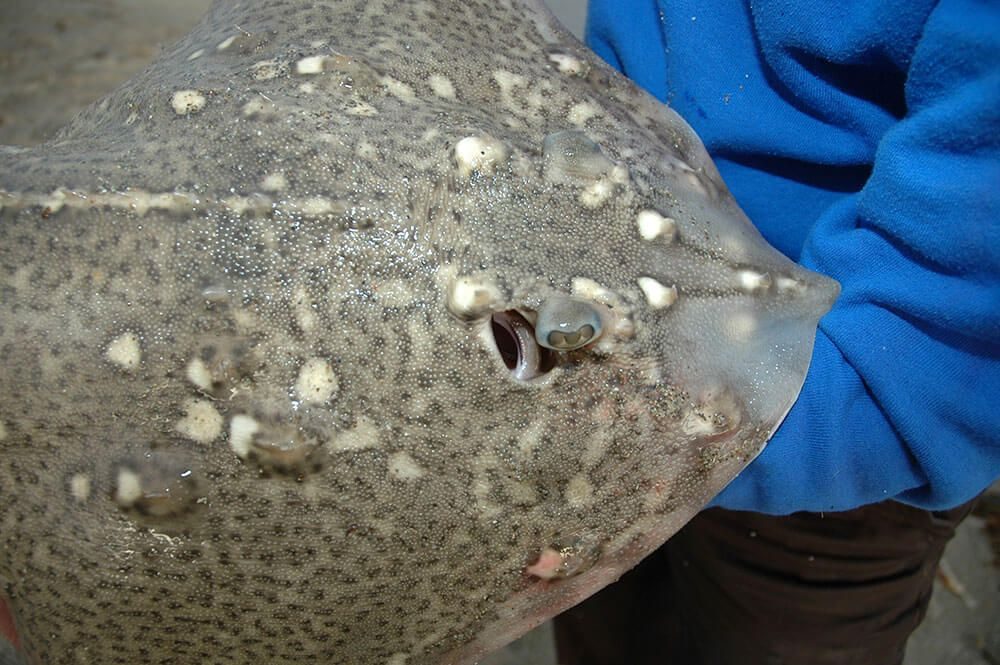
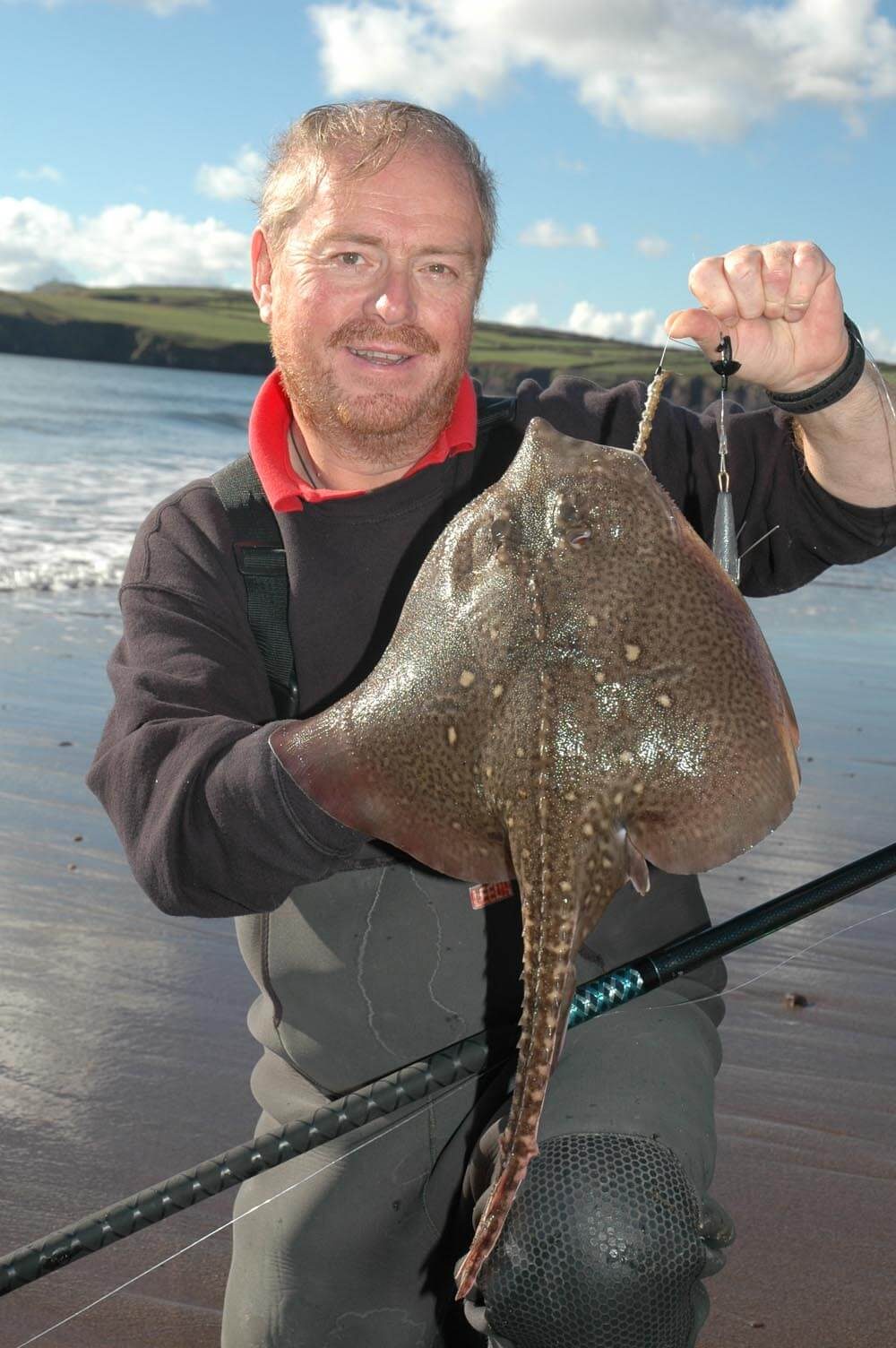
The thornback ray has a broadly rhomboid disc with a moderately pointed snout. The most distinctive identification feature is the thorns: as well as the row of spines along the midline of the tail (present in most British rays), the thornback has prominent, raised, button-like thorns scattered across the upper disc and in rows along the tail. Large individuals, especially females, have very prominent thorns on the disc. In males, clusters of hooked “alar spines” appear in the pectoral region during breeding.
Colouring is variable: typically a warm yellowish-brown to grey-brown above with darker spots and blotches, often irregular pale patches. No two fish are quite the same. The underside is white.
Distribution
Found throughout the north-eastern Atlantic from Iceland and Norway south to the Canaries, and throughout the Mediterranean, Black Sea and western Indian Ocean. Around the British Isles it is present on all coasts and is the dominant ray species in the southern North Sea, the English Channel, the Irish Sea and most other British fishing grounds.
Habitat
Sandy, muddy and mixed seabed from the intertidal zone to around 300 m, most commonly between 10 m and 60 m. Moves into shallower, warmer water in spring and summer to feed and breed, returning to deeper water in winter.
Diet
Fish, crustaceans and other bottom-living invertebrates, seized and crushed by the powerful flat teeth.
History
The thornback has been commercially fished in British and Irish waters for centuries. It is still landed commercially as “skate” or “ray” in British fish markets. As an angling species it is the definitive ray, targeted from boats on clean and mixed ground from the earliest spring through autumn. The “roker” name is still common in East Anglia and the south-east.
Interesting Facts
The thornback lays eggs in leathery, rectangular mermaid’s purse cases that are often found washed up on British beaches. Each case is roughly 6–9 cm long before the tendrils, and takes around five months to hatch depending on water temperature.
Near Threatened status reflects historical declines in some populations from commercial fishing, though most British stocks are in reasonable condition under modern management.
For the best marks, seasons and rigs, see our How to Catch Rays guide.