Hard-fighting, handsome and a magnet for the lure angler, the pollack is one of the most sporting members of the cod family in UK and Irish waters. From kelp-fringed rock marks to deep offshore wrecks, it offers fast, savage fishing that has earned it a devoted following. This guide looks at the pollack as a species, before the tackle comes out.
Identification
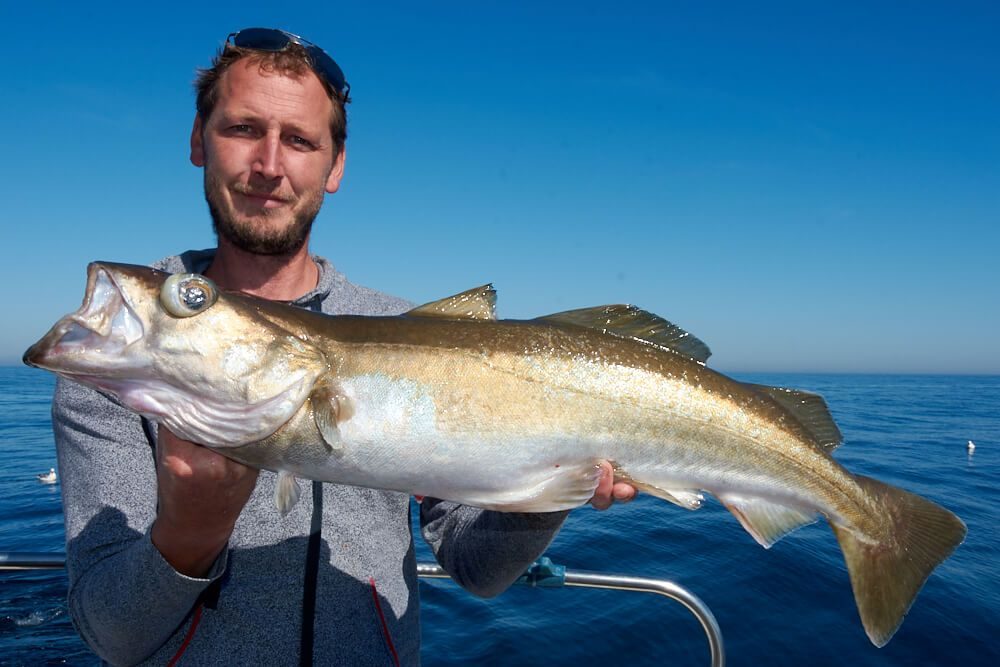
The pollack is a sleek, powerful fish with a pointed head and a notably protruding lower jaw that juts beyond the upper – an instant identifier. It has no chin barbel.
It carries the three dorsal and two anal fins typical of the cod family, set on a streamlined, muscular body built for chasing prey. The most reliable feature for separating it from the closely related coalfish is the lateral line, which in the pollack is dark and distinctly curved, bending over the pectoral fin.
Colouring is a rich greenish-brown to dark olive on the back, with bronze or golden flanks and a grey to off-white belly. Fish from different grounds vary in shade, but the dark, crooked lateral line and undershot jaw are constant.
Distribution
The pollack is a north-eastern Atlantic species, ranging from Iceland, the Faroes and Norway down to the Bay of Biscay, with scattered records into the southern Baltic.
It is common and widespread around the whole of the British Isles and Ireland. The rocky, reef-strewn coasts of the west and south-west – Cornwall, Wales, western Scotland and the Irish coast – are particularly noted for producing both good numbers and the largest fish.
Habitat
Pollack are fish of hard, broken ground. They are found inshore over rocky areas, reefs and kelp beds, and out to around 200 m over wrecks and offshore reef systems.
The species has a clear life pattern tied to age. Juveniles are pelagic and spend their first two or three years close to shore among rocks, kelp, sandy shores and estuaries, often shoaling with young coalfish. As they grow, larger fish move out to deeper rocky ground at around 40–100 m, where the specimen fish live around wrecks, reefs and even oil platforms.
Diet
The pollack is a committed fish-eater and an active hunter. Sandeels are a particular favourite, along with sprat, herring, small pouting, poor cod and the young of other species.
Smaller pollack take crustaceans and worms, but the diet swings firmly towards fish as they grow. They typically ambush prey from cover or rise up through the water column to intercept baitfish – behaviour that explains why a lure worked up and away from a wreck draws such ferocious takes.
History
Pollack has always been a useful food fish, though it has historically been ranked below cod and haddock for the table – its flesh is paler and softer, and considered drier in flavour. For much of its history it was a fish of local importance rather than a major commercial target.
That has shifted in modern times. As premium whitefish stocks have come under pressure, pollack has gained ground both commercially and, increasingly, as a sustainable eating fish. For the angler, though, its real value has always been as a sport fish, and concern over heavier commercial and recreational pressure on inshore stocks has grown in recent years even though the species remains assessed as Least Concern.
Interesting Facts
The pollack’s first run is the stuff of legend among rock and wreck anglers. On taking a lure it powers straight back down towards cover with astonishing speed, and a big fish hooked over a wreck can be almost impossible to turn – a fight out of all proportion to its size.
Juvenile pollack will hold and defend a feeding territory, unusual behaviour for a young shoaling fish.
In Scotland the fish is widely known as the lythe, a name worth knowing when travelling and talking marks with local anglers.
Despite reaching well over 100 cm, the pollack is comparatively short-lived for its size, with a maximum recorded age of only around eight years – it simply grows fast.
For lure choices, wreck and rock tactics and the top marks, see our full How to Catch Pollack guide.