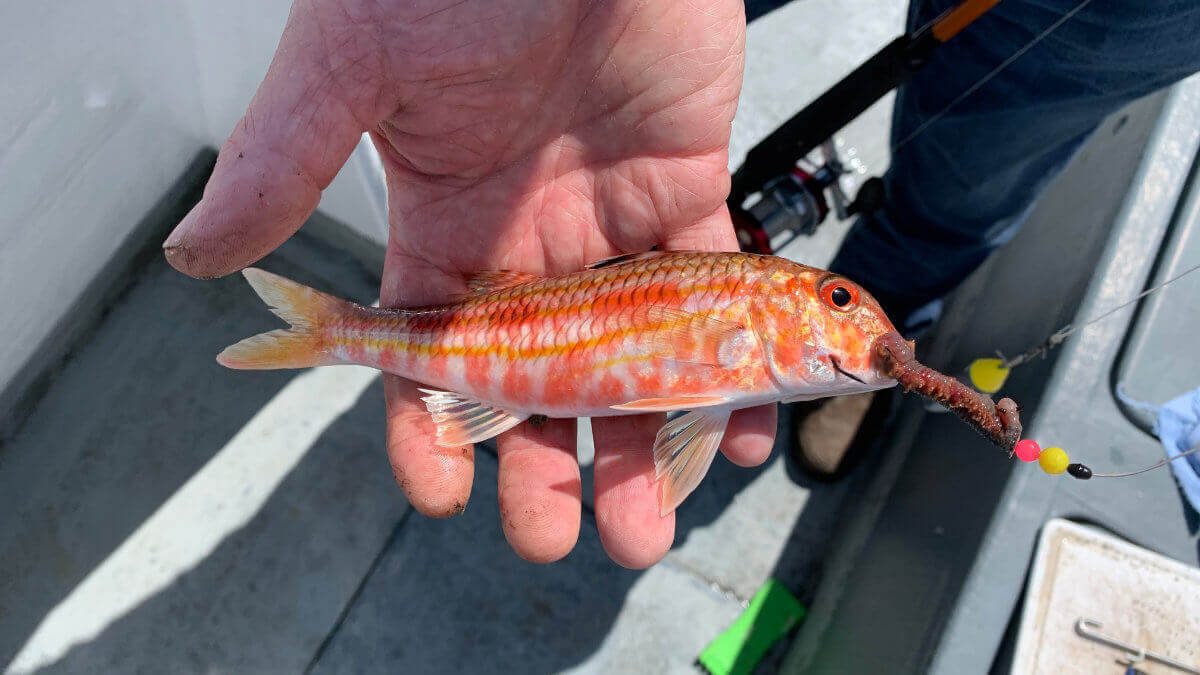
The red mullet is the finest table fish regularly encountered in British and Irish coastal waters — a vivid, warm-coloured goatfish that is unrelated to the grey mullets despite sharing the name, and is one of the most prized species in European seafood cookery. This guide looks at the species itself.
Identification
The red mullet is unmistakable: the body is a vivid red-pink to orange-red overall, marked with two or three paler yellowish or whitish horizontal stripes along the flanks. The head is steeply profiled with a blunt snout. Two distinctive long chin barbels hang below the jaw — the diagnostic feature of the goatfish family. The first dorsal fin has dark markings along it, which separates this species from the plain-finned Mullus barbatus (plain red mullet).
Despite the shared name, red mullet bears no close relation to the grey mullets — it is a goatfish (family Mullidae) in an entirely different order.
Distribution
Found in the eastern Atlantic from the Norwegian Sea south to West Africa, and throughout the Mediterranean and Black Sea. Around the British Isles it is most common in the south and south-west, with the Channel, western approaches and Irish Sea the main areas. Numbers increase further south and the species is abundant in the Mediterranean.
Habitat
Sandy and muddy seabeds and mixed ground from around 3 m to 90 m depth, occasionally found over rocky ground. The barbels are used to probe the sediment for buried prey.
Diet
Small crustaceans, worms, molluscs and other small invertebrates buried in sand and mud, detected by the highly sensitive chin barbels which function as a combined touch-and-taste organ.
History
The red mullet has been one of the most prized food fish of the Mediterranean and southern Europe since antiquity — the Romans paid extraordinary prices for large specimens and kept them in private ponds. In Britain it has become increasingly common in restaurants and fishmongers as stocks of more familiar species have come under pressure.
Interesting Facts
The chin barbels are extraordinary sensory organs, equipped with both mechanoreceptors and chemoreceptors (taste buds), allowing the fish to detect buried prey by touch and taste simultaneously as it scans the seabed.
The colour of a freshly caught red mullet fades quickly — the vivid red of a fish just out of the water becomes paler and pinker within minutes. The name in several European languages references this beautiful fresh colour.
For light-tackle tactics and the best southern marks, see our red mullet features.