The ling is the giant of the cod tribe in UK and Irish waters – a long, snake-bodied, big-jawed predator that haunts the wrecks and reefs and gives the boat angler one of the hardest, most dogged fights of all. It is technically a cousin rather than a true cod, but it is firmly part of the gadoid clan and a serious prize. This guide looks at the ling itself.
Identification
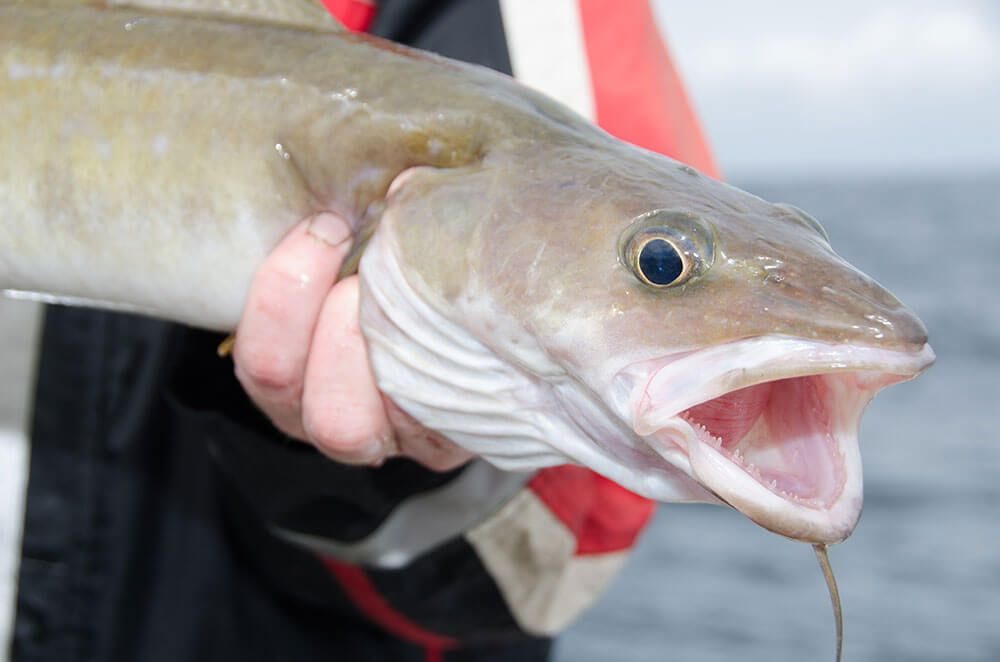
The ling is unmistakable once seen: a very long, slender, almost eel-like body that can stretch to two metres. The head is large with a broad mouth full of sharp teeth, and a single barbel hangs from the chin.
The long second dorsal fin and the anal fin run far down the body towards the tail, giving the fish its sinuous outline. The back is a marbled grey-brown to bronze-green, fading to a pale belly, often with darker mottling along the flanks.
Though it belongs to the family Lotidae – the lings and burbots – rather than the true cods, the single chin barbel and cod-like fins place it clearly among the gadoids. It is essentially an oversized, elongated relative of the rocklings.
Distribution
The ling is a fish of the cooler north-eastern Atlantic, ranging from the Barents Sea and Iceland south to Morocco, with a foothold in the north-western Mediterranean and scattered records off southern Greenland and Canada.
Around the British Isles and Ireland it is widespread but most abundant in the north and west, where deep water and rough ground lie close to the coast. Western Scotland, the Northern Isles and the deep reefs and wrecks off the Irish and Cornish coasts are classic ling country.
Habitat
This is a fish of deep, rough ground. Adult ling live mainly between 100 m and 400 m, though they range from around 100 m down to 1,000 m, and are tied closely to structure – wrecks, rocky reefs, pinnacles and boulder ground where they can lie up in cover.
Younger fish are found shallower and more widely, moving deeper as they grow. The species is essentially solitary and territorial, with the biggest fish holding the prime lies on a wreck.
Diet
The ling is an out-and-out predator built around its large, toothy mouth. Fish make up the bulk of its diet – flatfish, smaller gadoids such as cod, pouting and poor cod, plus herring, and anything else it can ambush.
It will also take crustaceans, squid and cuttlefish. A ling feeds by lying in wait amid the wreckage or reef and engulfing prey that strays too close, which is exactly why a fish bait fished hard into structure is the classic approach for them.
History
Ling has been an important food and trade fish in northern Europe for centuries. Like cod, it salts and dries extremely well, and salted ling was once a staple winter food and a valuable export, particularly from Scotland, Scandinavia and Iceland.
It remains a commercial species today, taken on longlines and by trawl, and is valued for its firm white flesh. Despite sustained fishing pressure it is wide-ranging and resilient enough to be assessed as Least Concern.
Interesting Facts
The ling is enormously fecund. A large female can carry tens of millions of eggs – figures running into the tens of millions have been recorded – released in deep water to drift on the currents.
It is a long-lived fish, reaching around 25 years of age, which helps explain how it grows to such a size.
Many of the very biggest rod-caught ling come from the famous tidal grounds of Norway, where the cold, deep, food-rich water grows specimens far beyond the British average – the shore-caught record, a fish of around 59 lb, came from Saltstraumen.
Old ling lose much of the marbling of their youth and can take on a more uniform bronze hue, while the inside of the mouth is often strikingly pale.
For wreck tactics, baits and the best deep-water marks, see our full How to Catch Ling guide.