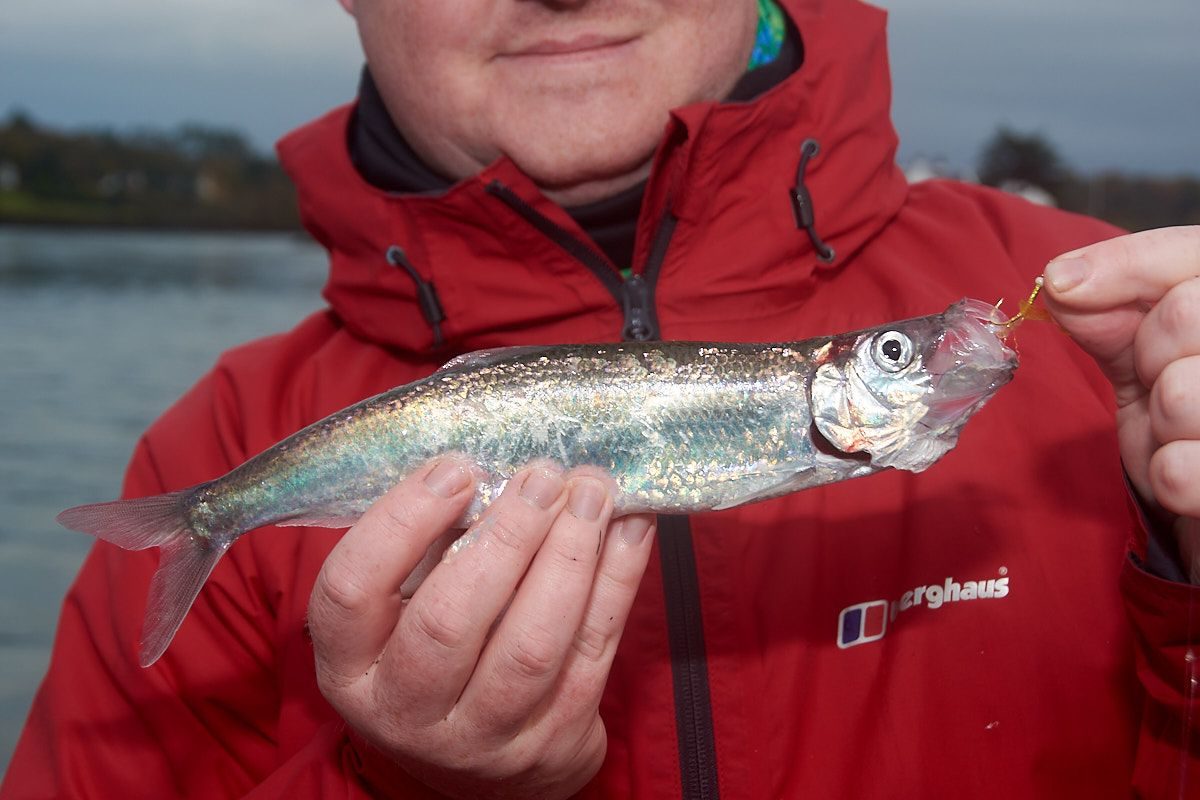
The herring is one of the most ecologically important fish in the North Atlantic — the silver shoaling fish that has fed populations, built economies and sustained entire ecosystems for thousands of years. Once so abundant that vast seine nets were filled by the billion, it remains central to the food web of the North Sea, the Irish Sea and every other British and Irish fishing ground. This guide looks at the species itself.
Identification
The herring is a sleek, silvery, streamlined shoaling fish with a single short dorsal fin set about the midpoint of the body, a forked tail and no adipose fin. The body is laterally compressed, the back a steely blue-green and the flanks and belly bright silver.
Distinguished from sprat by being larger and by the position of the dorsal fin, which starts above or just in front of the pelvic fins (in the sprat it starts behind them). No lateral line is visible, and there is a row of small scutes along the keel of the belly.
Distribution
The Atlantic herring has a vast distribution across the North Atlantic, from Labrador and the eastern seaboard of the US across to Iceland, the whole of the North Sea, the Norwegian Sea, the Baltic, the Irish Sea, the English Channel and the Celtic Sea. It is one of the most widespread fish in the Atlantic.
Habitat
A pelagic, mid-water and surface shoaling fish found from near the surface down to around 200 m. Herring form enormous shoals and undertake long seasonal migrations between spawning grounds (shallow, nearshore rocky reefs) and feeding grounds. They come close inshore and into bays and estuaries in summer and autumn.
Diet
Herring feed primarily on zooplankton — copepods especially — filtering them from the water, along with small crustaceans, larval fish and other tiny organisms. They are filter-feeders as much as active hunters.
History
Few fish have shaped human history as profoundly as the herring. The medieval herring trade of the North and Baltic Seas financed the Hanseatic League, built port towns from Yarmouth to Bergen, and fed northern Europe through centuries of winter. The collapse of the great Yarmouth herring fishery in the twentieth century from overfishing ended an industry stretching back to the Domesday Book.
Herring stocks have fluctuated enormously under commercial pressure and are now managed under strict international catch limits. Despite this the species remains Vulnerable on the IUCN assessment.
Interesting Facts
Herring spawning takes place on specific gravel and rocky reef sites, with the adhesive eggs laid in layers that can be metres thick in productive years. The fry that hatch are among the most important food items for virtually every commercially fished species in the North Atlantic.
The collective noun for a group of herring is a “shoal” or “glean”, and the shoals can be extraordinary in scale — at their historic peak, commercial catches numbered in the billions of individual fish per season.
For light-tackle herring fishing and its role as bait, see our herring features.