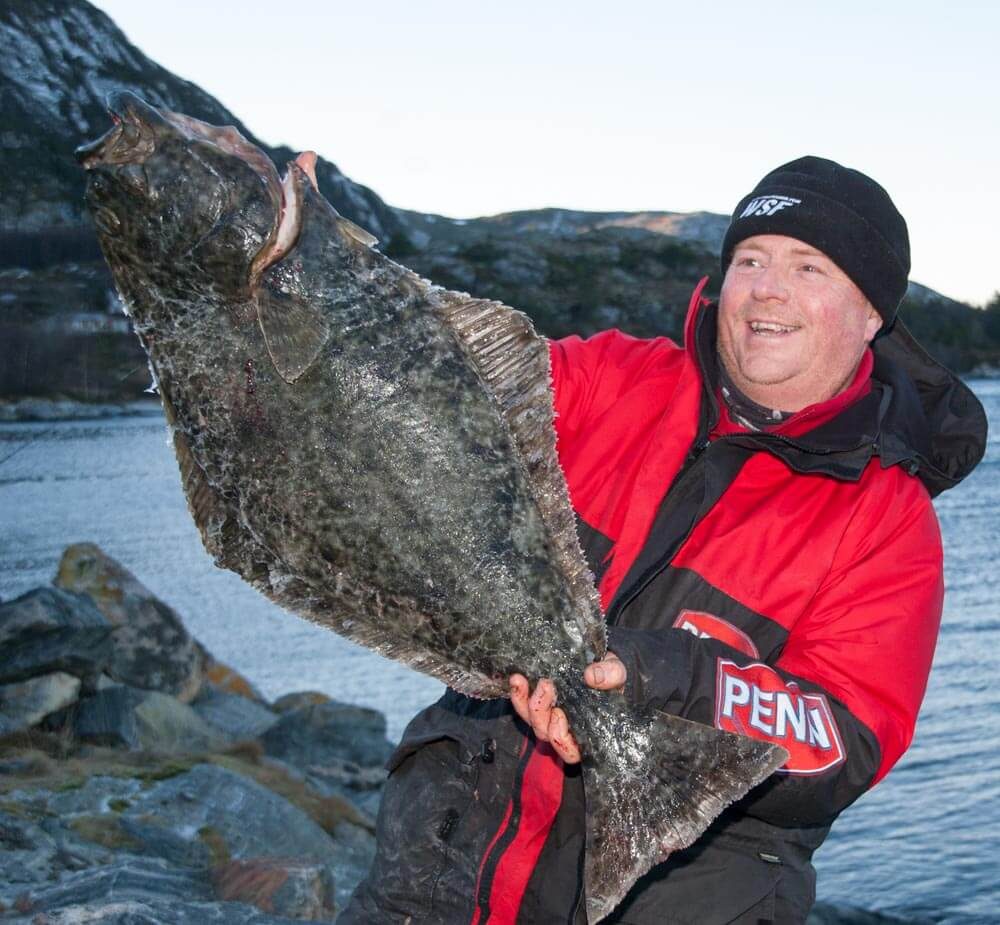
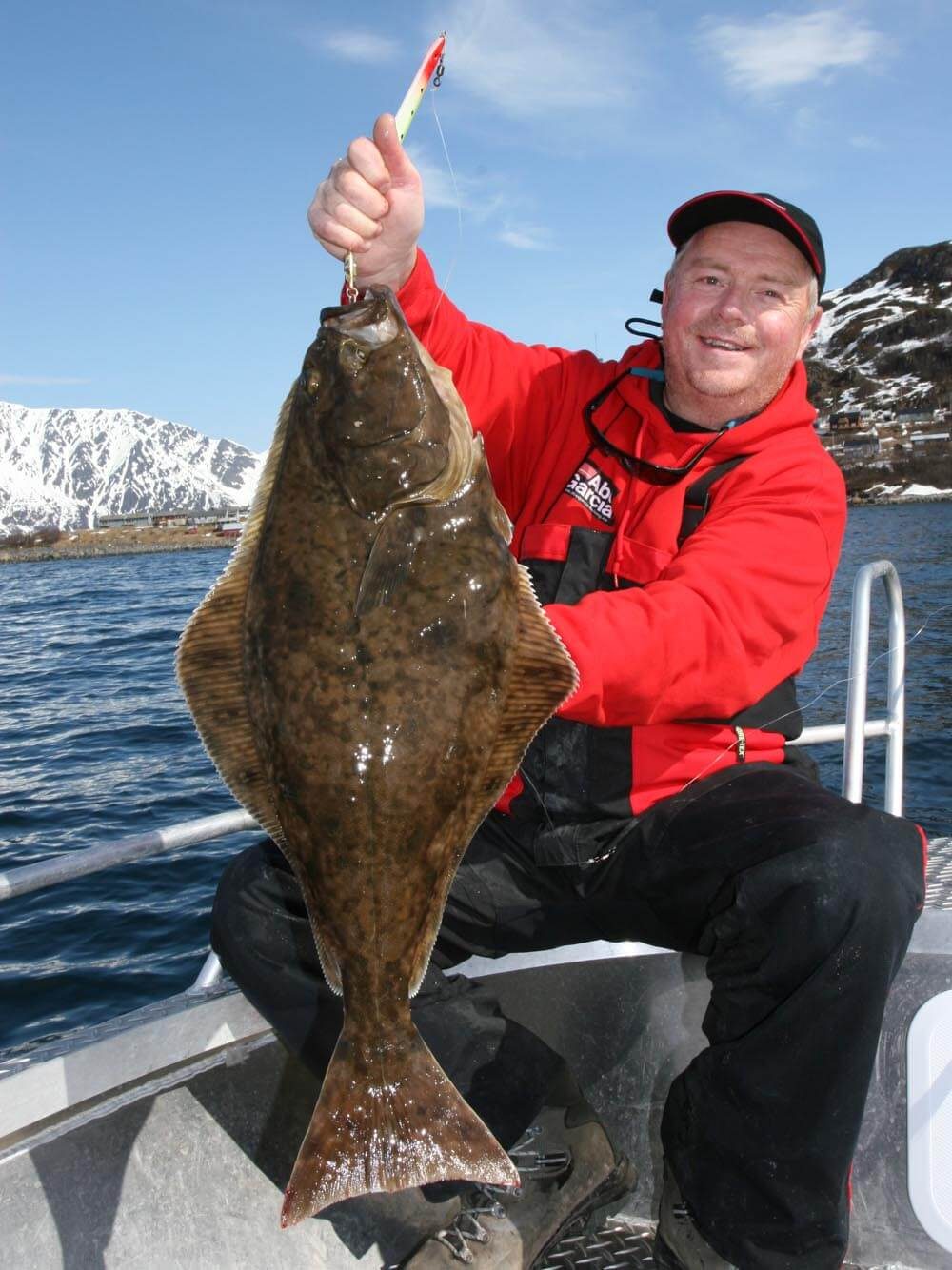
The halibut is the largest flatfish in the world and one of the greatest prizes in British and Irish sea angling — a massive, powerful predator that combines the size of a large shark with the camouflaged stealth of a flatfish. A single halibut is the ambition of a lifetime for many northern boat anglers. This guide looks at the species itself.
Identification
The halibut is a right-eyed flatfish — both eyes on the right side — with a body considerably longer and less circular than most flatfish, giving it a more conventional fish-shaped outline when viewed face-on. The body is dark brown to black on the upper surface, often with paler mottling in younger fish; the underside is white.
The mouth is large with strong teeth — far more so than any other British flatfish — reflecting its highly predatory diet. The lateral line has a pronounced arch above the pectoral fin. The caudal fin is slightly concave in large specimens (unlike the more rounded tail of smaller fish).
Females grow considerably larger than males and are responsible for the largest rod-caught fish.
Distribution
The halibut has a circumpolar distribution in the cold waters of the North Atlantic and adjacent Arctic, from Labrador and Greenland to Iceland, the Barents Sea and south to the Bay of Biscay. Around the British Isles the main populations are off northern and western Scotland, Shetland, Orkney and the deep water off the Irish north and west coast.
Habitat
A demersal fish of deep, cold water, typically between 50 m and 2,000 m, but most commonly between 200 m and 700 m over sand, gravel and clay. Adults are largely benthic but can also be found in midwater when hunting.
Diet
One of the most actively predatory of all flatfish. Halibut feed heavily on other fish — cod, haddock, herring, sand eel, capelin and many others — as well as cephalopods and large crustaceans. Large individuals are apex predators of the deep northern grounds.
History
The halibut has been commercially fished for centuries and was once far more abundant around the British Isles. Heavy fishing pressure through the 19th and 20th centuries dramatically reduced populations, and it is now rare enough in British and Irish waters to merit Near Threatened status.
It is managed through catch limits in European waters, and the British angling community takes a largely catch-and-release approach to any halibut caught.
Interesting Facts
The halibut is not only the world’s largest flatfish but also one of the largest bony fish of any kind — the maximum recorded weight of over 700 lb dwarfs most fish an angler could encounter.
It is slow-growing and late-maturing, not reaching sexual maturity until around 10–14 years old, which makes it highly vulnerable to overfishing. A 200 lb halibut may be 30 or more years old.
Halibut are occasionally encountered as pelagic fish, hunting well up off the bottom in pursuit of shoaling fish — a surprising behaviour for what is considered a bottom fish.
For deep-water tactics and the northern marks, see our halibut and deep-water features.