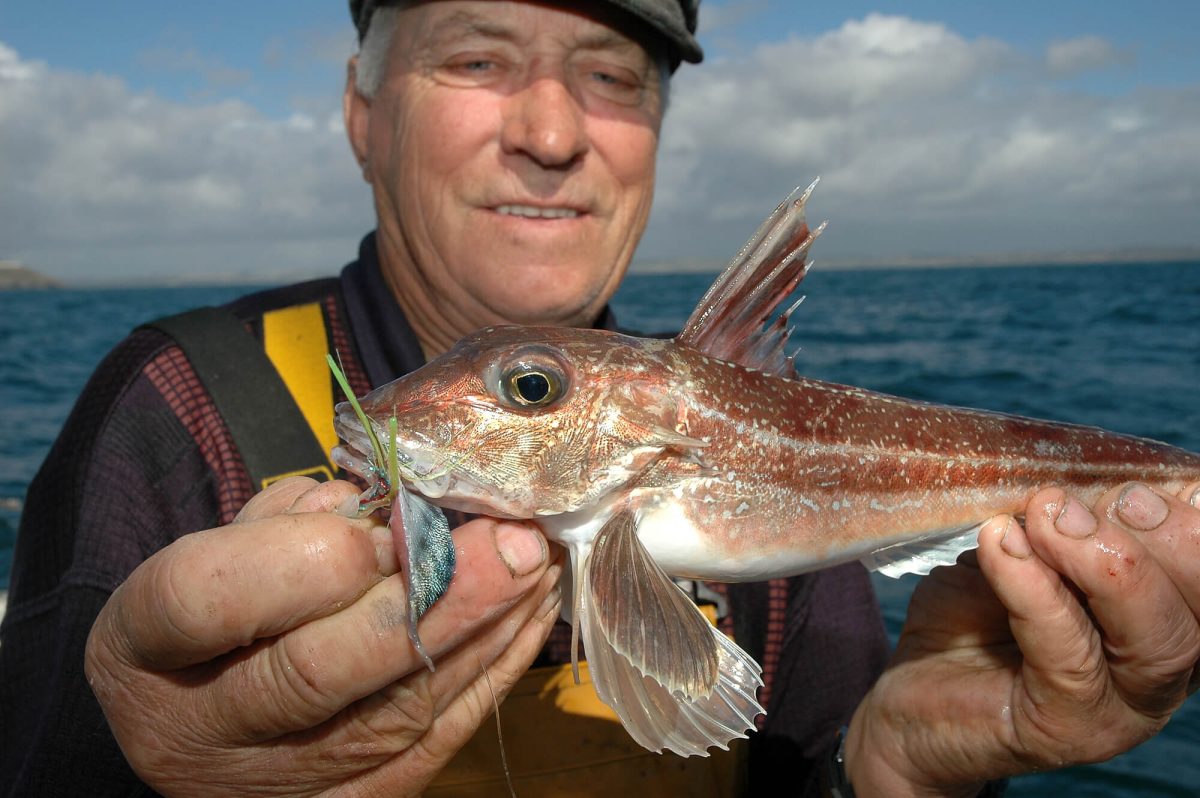
The yellow gurnard — more correctly the tub gurnard — is the largest and arguably the most spectacular of the British gurnards. It has vivid electric-blue edged pectoral fins, a robust build and is the most sought-after of the gurnard family for both its appearance and its quality at the table. This guide looks at the species itself.
Identification
The tub gurnard is the biggest British gurnard and the most vivid. The body is a warm pinkish-red to orange-red, paler on the belly. The pectoral fins — the species’ signature feature — are large and fan-like, with a vivid interior of bright blue edged with electric blue-green, and scattered bright blue spots. Spread wide, they are among the most colourful sights British inshore waters offer.
It has the same three-ray feeler structure as other gurnards, and the characteristic bony armoured head. It is larger, more orange-red and more vividly finned than either the red or streaked gurnard.
Distribution
Found throughout the eastern Atlantic from Norway south to West Africa, and throughout the Mediterranean and Black Sea. Around the British Isles it is widespread but most common in the south and west.
Habitat
Sandy and mixed ground from shallow water down to around 300 m, most commonly between 20 m and 150 m. Prefers cleaner, firmer ground than the grey gurnard.
Diet
The tub gurnard is a more active hunter than the smaller gurnards, taking a higher proportion of fish alongside crustaceans and worms. The feeler rays probe the seabed for buried prey.
History
The tub gurnard is the most valued gurnard at the table — its firm, white, sweet flesh is well regarded in France and Spain, where it appears regularly in restaurants. In Britain it has grown in esteem as restaurants seek sustainable alternatives to premium whitefish.
For the boat angler it is a prized catch over clean ground, larger and stronger-fighting than the grey gurnard.
Interesting Facts
When the tub gurnard spreads its pectoral fins defensively or while walking, the full vivid blue-and-turquoise pattern is revealed — a display that has made it a favourite subject for underwater photographers.
The walk across the seabed on three feeler rays, with the huge pectoral fins raised like wings, gives it the appearance of a bizarre blue-finged creature quite unlike anything else on the bottom.
For boat fishing tactics on clean ground, see our How to Catch Gurnard guide.