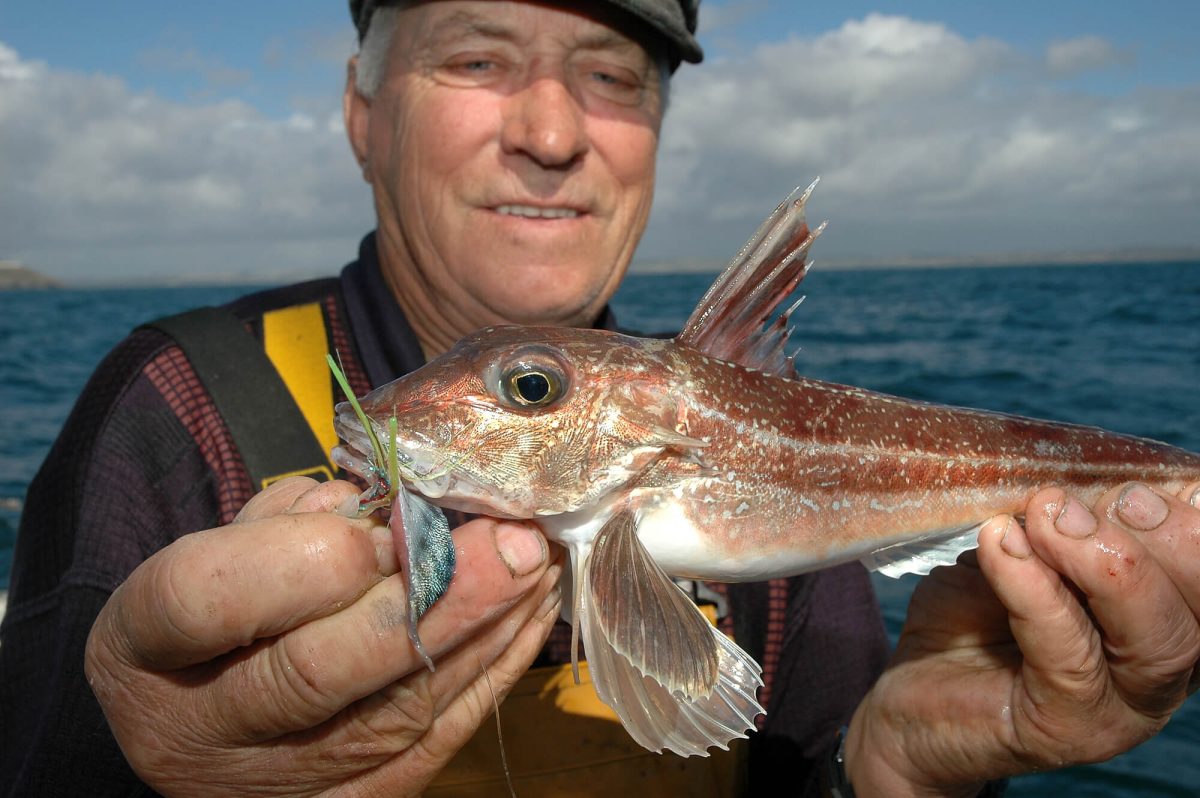
The red gurnard is among the most striking fish in British and Irish coastal waters — a vivid, warm-toned gurnard with bright pectoral fins that flashes with colour when brought to the surface. Occasional rather than common, it is a prized catch and a beautiful fish. This guide looks at the species itself.
Identification
The red gurnard shares the characteristic gurnard build — armoured bony head, three separated pectoral ray feelers per side, large rounded pectoral fins and a tapering body. It is immediately distinguished from the grey gurnard by its colouring: the body is a warm pinkish-red to orange-red, and the large pectoral fins are vivid red-orange with blue edges and blue spots, making it one of the most colourful fish encountered in British waters.
Distribution
Found in the eastern Atlantic from Norway south to West Africa and into the Mediterranean. Around the British Isles it is most common in the south and west, and is less frequently caught than the grey gurnard.
Habitat
Sandy and mixed ground from inshore waters to around 200 m, largely comparable habitat to the grey gurnard.
Diet
Crustaceans, worms and small fish, found by probing the seabed with the feeler rays.
History
The red gurnard is more prized at the table than the grey, with firmer, sweeter flesh, and is sold in fish markets across southern Europe. In Britain it is occasionally sold as “sea robin” or marketed at upmarket fishmongers.
Interesting Facts
The spectacular blue-edged, blue-spotted pectoral fin interior is fully revealed when the fin is spread — the fish can use these broad, vivid fins for display as well as for “walking” on the seabed.
The feeler rays contain taste buds and mechanoreceptors allowing the fish to detect buried prey.
See our How to Catch Gurnard guide for more on targeting gurnards from the boat.