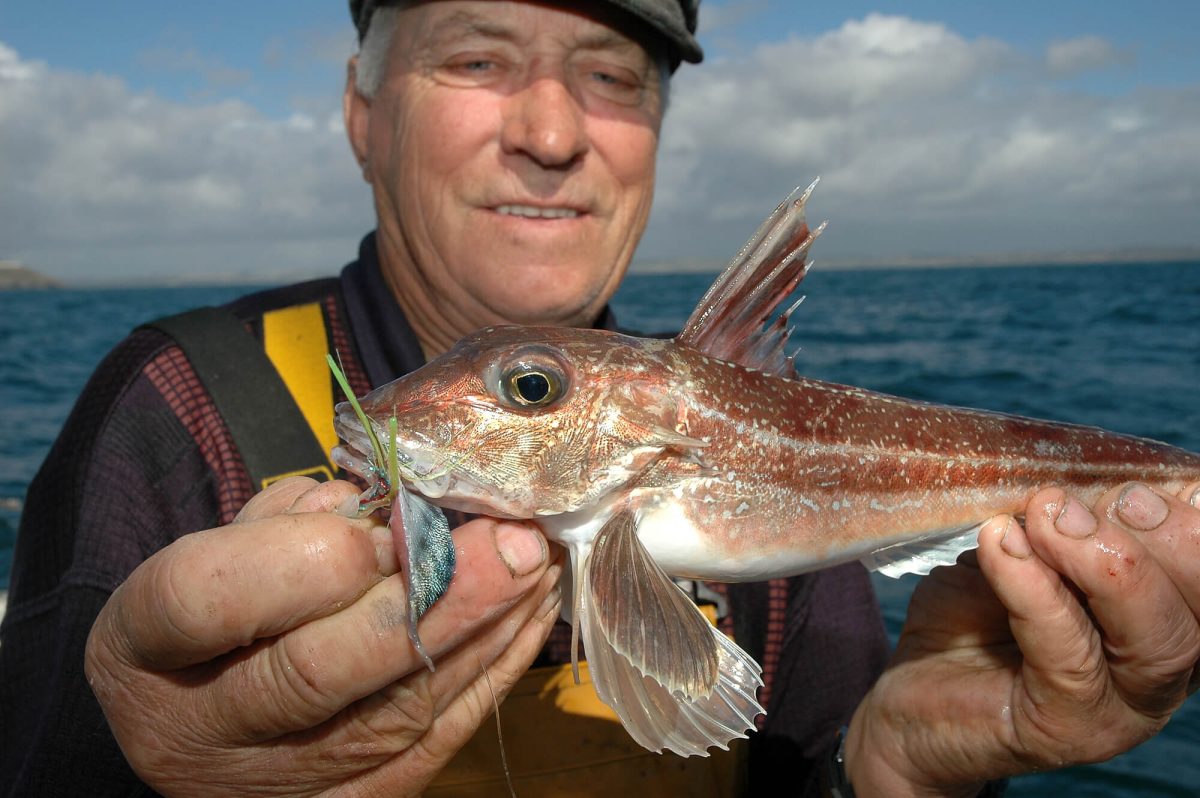
The grey gurnard is the most commonly caught of the British gurnards — a bottom-walking armoured fish that crawls across the seabed on modified fin rays, clattering when brought aboard and making itself very well known to anglers fishing over clean ground. This guide looks at the species itself.
Identification
The grey gurnard has the characteristic gurnard form: a large, bony, armoured head with a broad flat snout, large eyes and a mouth that opens downward. The body is covered in scales and tapers quickly to the tail. The pectoral fins are large and rounded, and the first three rays of each are separated from the rest to form three finger-like feelers used to “walk” across and probe the seabed.
Colouring is grey-brown with paler sides and belly, often with a scattering of whitish or pale spots on the flanks. The first dorsal fin is spiny and the lateral line carries a row of small scutes (spiny plates).
The grey gurnard is most easily confused with the tub gurnard, but is smaller and greyer, with a less vivid pectoral fin interior.
Distribution
Found throughout the north-eastern Atlantic from Norway and Iceland south to West Africa, and into the Mediterranean. Common all around the British Isles and Ireland over sandy and mixed ground.
Habitat
Sandy and mixed seabed from inshore waters down to around 200 m, with concentrations typically between 20 m and 100 m. A bottom-dwelling fish that actively probes the seabed with its pectoral ray feelers.
Diet
Feeds mainly on crustaceans, small fish and worms found by probing the seabed.
History
The grey gurnard is eaten in some parts of Europe but not widely in Britain. For the angler it is a common boat-fishing catch over clean ground, and occasionally taken from the shore.
Interesting Facts
The modified pectoral rays are not just for walking — they are richly supplied with sensory receptors and taste buds, functioning as tactile and gustatory organs that detect food below the sand surface.
Gurnards produce a drumming or grunting sound using specialised muscles on the swim bladder — hence the old name “crooner” in some regions.
See our How to Catch Gurnard guide for boat fishing tactics over clean ground.