The garfish is one of the most immediately recognisable fish in British and Irish coastal waters – a long, vivid green-and-silver needle of the surface, throwing itself clean of the water when hooked and giving superb sport on light tackle. A summer arrival that announces the mackerel season, it is a favourite of float anglers and spinning enthusiasts. This guide looks at the species itself.
Identification
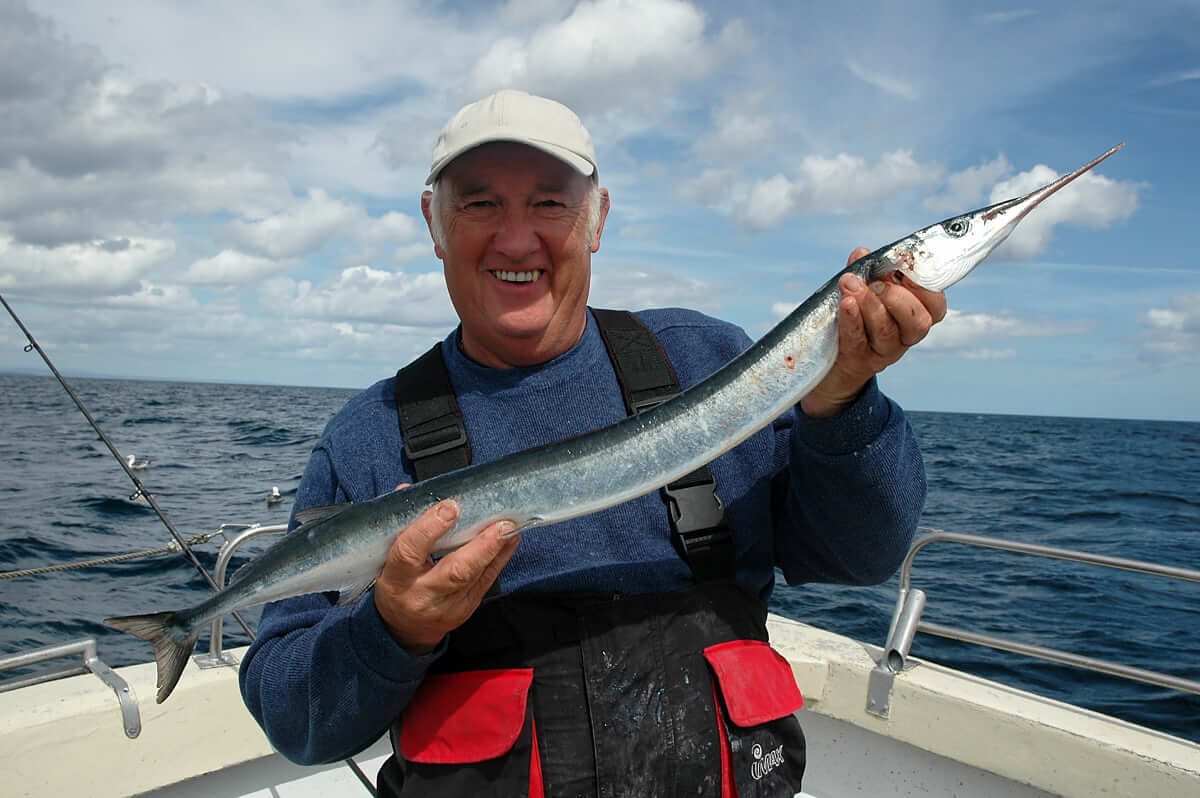
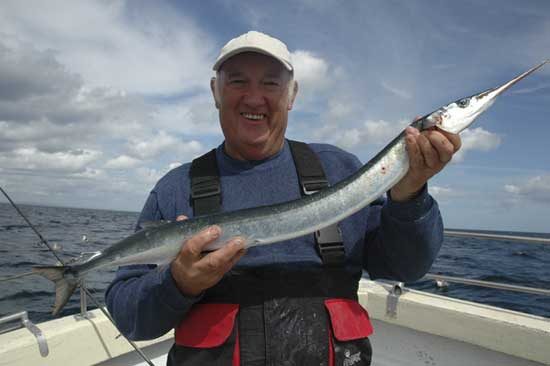
The garfish is unmistakable. The body is extremely elongated, slim and laterally compressed, with both jaws extended into a sharp beak lined with small teeth – the lower jaw slightly longer than the upper. The dorsal and anal fins are set far back near the tail, giving the fish a distinctive rear-heavy outline.
Colouring is bright metallic blue-green on the back with silver sides and a white belly. The scales are small and silvery. A dark stripe runs along the flanks at the lateral line.
The bones are bright green – one of the most startling features for anyone who cuts into a fresh garfish for the first time, and one that puts off many people from eating it, despite the flesh being entirely harmless and good to eat.
Distribution
The garfish is found throughout the eastern Atlantic from Norway south to Mauritania, and in the Baltic, Mediterranean and Black Seas. Around the British Isles it is a migratory summer visitor, arriving in spring with the warming of inshore waters and typically present from April to October.
Habitat
A surface-living, pelagic species of open coastal water. Garfish shoal at or very close to the surface, often leaping clear of the water when feeding. They follow the shoals of sand eel, sprat and small fish that sustain them inshore through summer, and are typically found over open water rather than close to the bottom.
Diet
An active hunter of small shoaling fish – sprat, sandeel, juvenile herring and small mackerel – which it pursues at speed through the surface layers. The long beak is used to seize fast-moving prey sideways before turning it headfirst to swallow.
History
The garfish is not a major commercial fish in Britain but has been eaten and valued in coastal communities for centuries. It is prized in Scandinavia and the Mediterranean, where the green bones cause no concern.
The old name “mackerel guide” comes from the traditional belief that garfish arrive just before the mackerel – a rough seasonal indicator that anglers still use.
Interesting Facts
The bright green of the bones and the spine alongside the vertebral column is caused by biliverdin, a harmless bile pigment. It stains all the skeletal and connective tissue of the fish a vivid emerald green, including the spine itself. The flesh is entirely normal in colour and perfectly good to eat.
The garfish is a superb light-tackle fish: hooked on a float rig or a small spinner, it leaps, tail-walks and fights out of all proportion to its size.
For tactics, floats and the best summer marks, see our How to Catch Garfish guide.