The conger is the largest eel in the world by weight – a powerful, muscular predator that haunts the deepest wrecks and the darkest rock holes and fights with a dogged, body-wrenching fury that has made it one of the most challenging targets in British and Irish sea angling. Mysterious, primeval and genuinely impressive, the conger earns every superlative. This guide looks at the species itself.
Identification
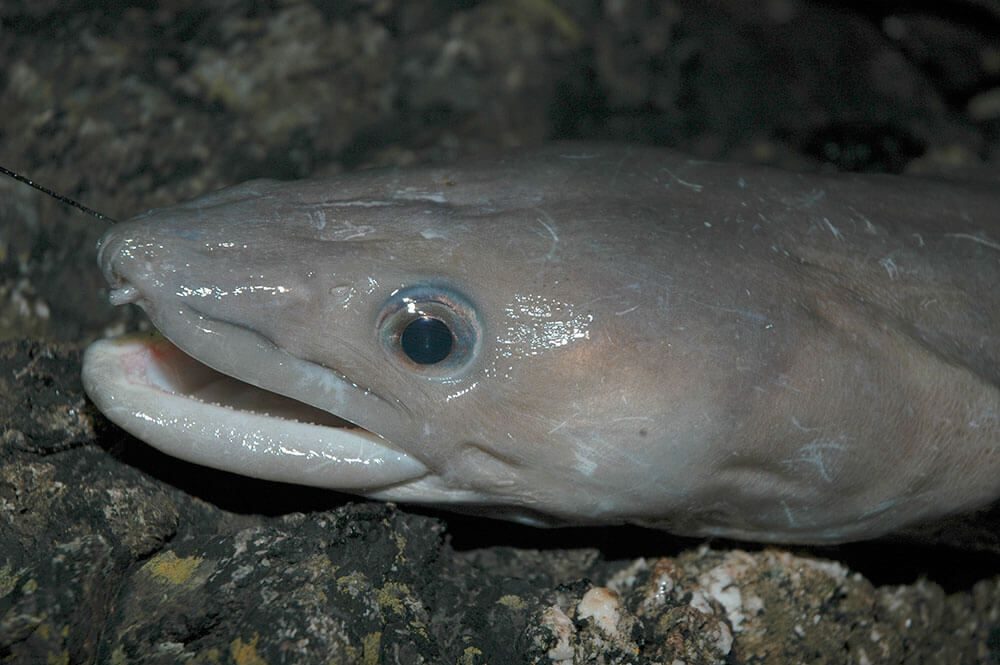
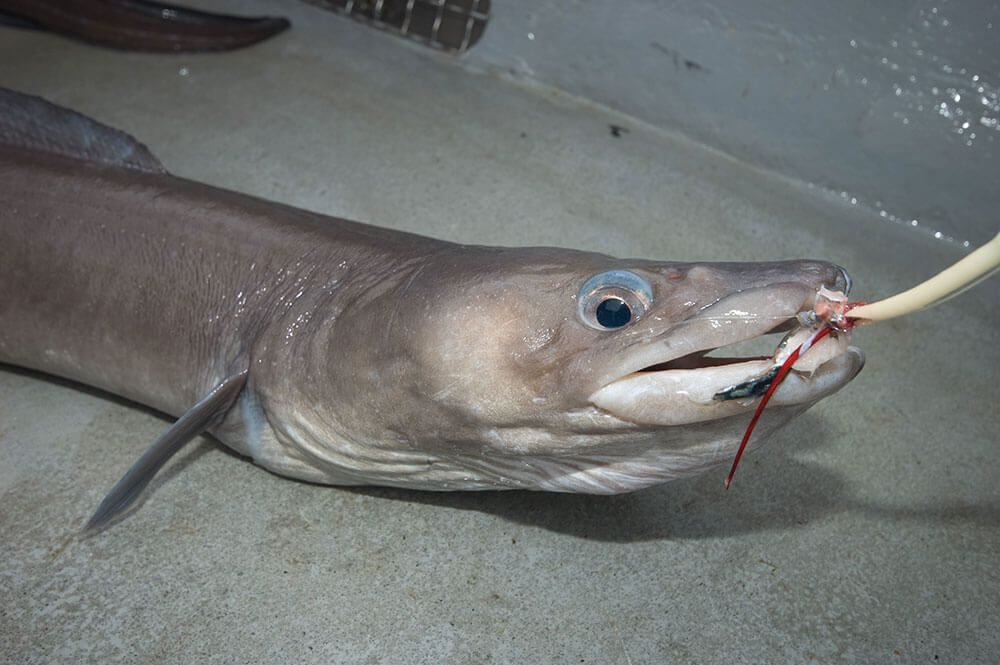
The conger is immediately recognisable as a large, scaleless, powerful eel with a smooth, muscular body that is round in cross-section rather than laterally compressed. The skin is grey to grey-blue or grey-black on the back, fading to a paler grey or off-white belly. The dorsal, tail and anal fins are fused into a single continuous fringe running most of the body length.
The upper jaw is longer than the lower – the opposite of the freshwater eel – and the eye is elliptical. Pectoral fins are present, unlike some other eels, and the gill slits are large and prominent.
Females are considerably larger than males: females mature at around 2 m and can grow substantially beyond that; males rarely exceed 1.2 m.
Distribution
The conger ranges throughout the eastern Atlantic from Norway and Iceland south to Senegal, and throughout the Mediterranean and Black Sea. Around the British Isles it is found on all coasts, but is most abundant in the south and west – Cornwall, Devon, South Wales, the south of Ireland and the Channel Islands being particularly famous conger grounds.
Habitat
A demersal fish of hard, structured ground – rocky reefs, wrecks, boulder ground, harbour walls, cave systems and rock holes. Young conger are found in the shallows; large adults inhabit deeper water from around 50 m to 500 m. They spend the day hidden in a lair, emerging at night to hunt.
The conger’s affinity for wrecks is well known: artificial hard structure attracts the fish and the prey fish that feed there, and the largest shore and boat records come from wreck fishing.
Diet
The conger is a carnivore that feeds on fish, crustaceans, cephalopods and pretty much anything it can overpower. Large individuals take substantial prey including other congers, small sharks, dogfish and whatever fish move within range of the lair. The jaws are powerful enough to crush the shell of a large crab with ease.
History
The conger has been fished and eaten around the Mediterranean and Atlantic for thousands of years. In medieval Britain dried and salted conger was a valued food fish. Commercial fishing by trawl and longline still takes substantial numbers.
For the rod-and-line angler the conger is a classic quarry – a species with a devoted following, particularly for wreck fishing from boats and night fishing from rocky marks and harbour walls.
Interesting Facts
After years or decades living and growing in British and Irish waters, mature female congers undertake a final, epic migration to deep water in the mid-Atlantic – possibly to the vicinity of the Azores – to spawn. They spawn only once, releasing millions of eggs, and then die. The larvae drift back to European coasts on ocean currents as transparent leptocephalus larvae.
This single-spawning, migrate-and-die strategy means that a mature female conger removed from the population is a permanent loss.
The largest authenticated rod-caught conger from the British Isles weighed 133 lb 4 oz, caught on a wreck off Brixham. Commercial catches running to 100 kg+ are reliably documented.
For wreck tactics, baits and handling advice, see our How to Catch Conger guide.