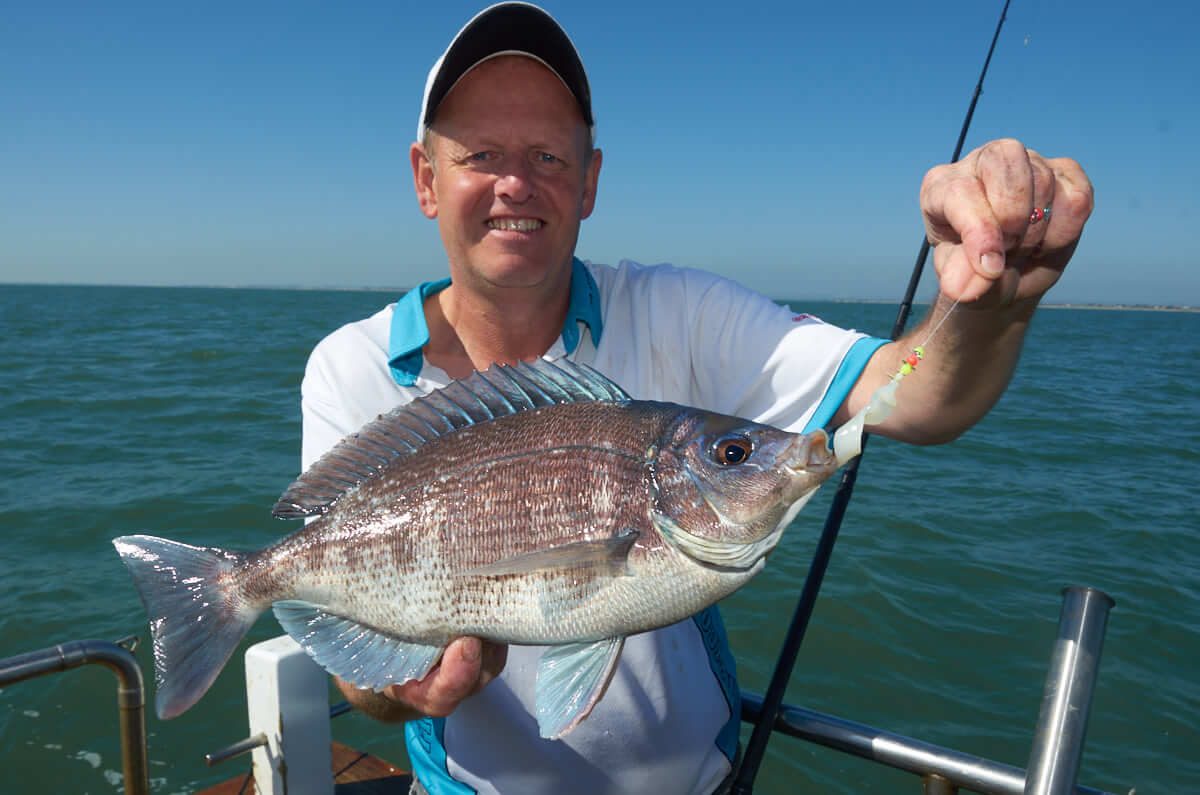
The black bream is the premier sea bream of British and Irish summer angling – a handsome, hard-fighting inshore fish that arrives each spring to spawn over clean ground and provides excellent sport through to early autumn. This guide looks at the fish itself.
Identification
The black bream is a deep-bodied, oval, moderately compressed fish with a single continuous dorsal fin running most of its length – the front portion spiny, the rear soft-rayed. The tail is well forked.
Colouring is variable. Outside the breeding season fish are grey to silvery, with several horizontal golden or dark stripes along the flanks and a paler, sometimes white belly. Breeding males darken dramatically, becoming a deep, dark grey to near-black with a vivid white bar just behind the head and an intensely blue-white sheen on the flank – a transformation that has given the fish its name.
Both jaws carry rows of sharp incisor-like teeth at the front, designed for nipping off weed, crustaceans and molluscs.
Distribution
The black bream is found in the eastern Atlantic from Norway south to West Africa, throughout the Mediterranean and into the Black Sea. Around the British Isles it is common in the south and west, with the English Channel, the Bristol Channel and the coasts of South Wales and Southern Ireland being particularly productive.
Habitat
A fish of clean, hard ground – rocky reefs, kelp beds, rough and mixed seabed and the hull plates of wrecks. Adults are found from the shallows down to around 300 m, but most are encountered between about 15 m and 80 m in UK and Irish waters.
The species is inshore and relatively coastal, with a clear seasonal pattern: fish move into shallow coastal grounds to spawn from about April, peak through summer, then move offshore as autumn sets in.
Diet
Black bream are omnivorous, picking off crustaceans, worms, small molluscs and small fish from rocky and rough ground, and also grazing on weed. The sharp front teeth are designed for this varied, opportunistic diet.
History
The black bream has been a recognised angling target for over a century, particularly along the south coast of England. The spawning fish build and guard nests on sandy patches among rock in spring, making them concentrated and catchable. Colne Point in Essex, the Chesil Beach area and Torbay are historically famous bream marks.
The species is protogynous – all fish are born as females and some later change sex to become males. Breeding males defend territories vigorously and are typically the larger fish in a group.
Interesting Facts
Male black bream are among the most attentive fathers in British fish life. They build a shallow nest on the seabed by clearing a depression in sandy ground, then guard the eggs with real aggression until hatching – behaviour unusual among marine fish.
During the nest-building and spawning period the male’s darkening and the vivid white flank bar are so pronounced that early naturalists sometimes described them as a different species entirely.
For rigs, marks and seasonal tactics, see our How to Catch Black Bream guide.