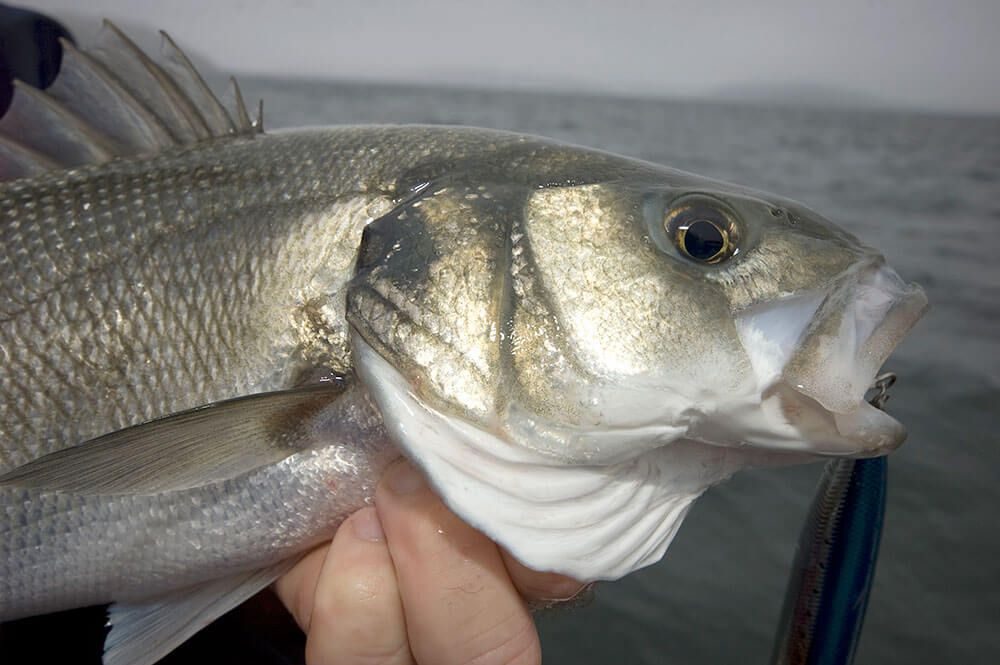
The bass is the undisputed king of British and Irish inshore sea angling. Fast, powerful, cunning and achingly beautiful, it has a following matched by no other species in our coastal waters. Whether you’re chasing them off a rocky headland at midnight or lure-fishing an estuary at dawn, the bass earns its reputation every single time. This guide looks at the fish itself.
Identification
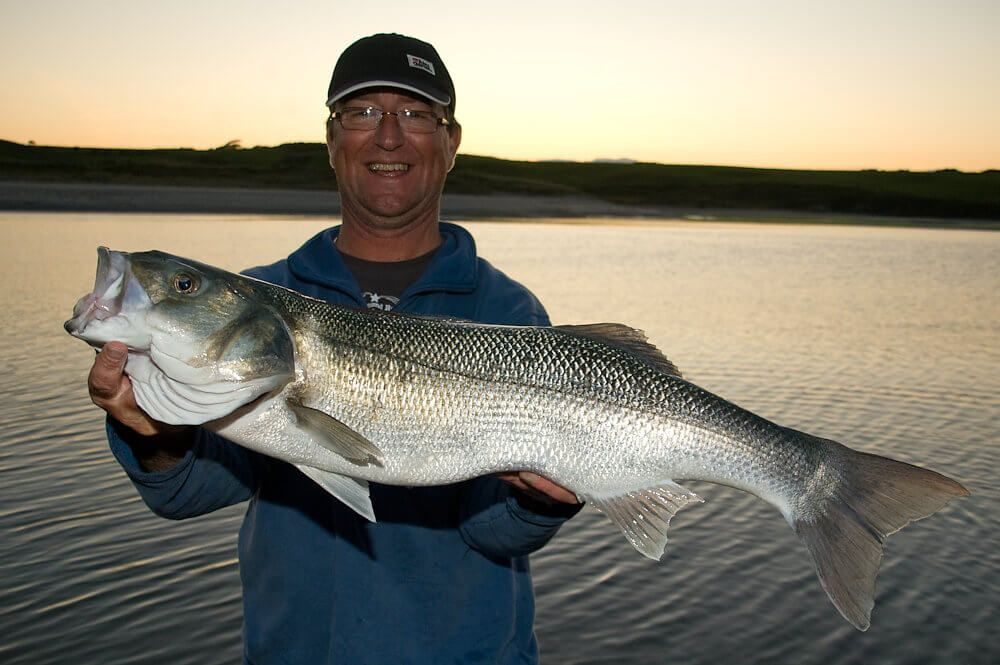
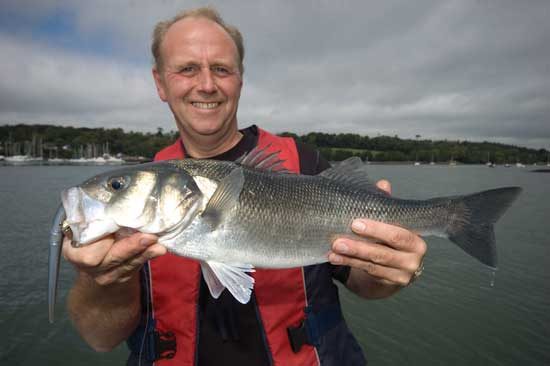
The bass is an unmistakable, beautifully proportioned fish. The body is streamlined, muscular and moderately deep, covered in large, silvery scales. The back is a steely grey-green, the flanks bright silver and the belly white. The overall impression is of a fish built for speed and power.
It has two separate dorsal fins – the first armed with stiff spines, the second soft-rayed – and stout, spiny gill covers. The large mouth is set at the end of a slightly pointed head, ideal for pursuing fast-moving prey.
Juveniles up to around two years old often show small black spots on the flanks, gradually fading as they mature. Young bass can be confused with bass perch or the thin-lipped mullet, but the distinctive two-part dorsal fin and spiny gill covers are always diagnostic.
Distribution
The European bass is found throughout the eastern Atlantic from Morocco north to southern Norway, and throughout the Mediterranean and Black Sea. In the British Isles it is common in the south and west – the English Channel, the West Country, Wales, Ireland and the south-west approaches hold the strongest populations.
The fish has extended its range northward in recent decades as sea temperatures have risen, and is now encountered more regularly in Scotland than historically.
Habitat
Bass are remarkably versatile and are found in almost every inshore habitat available to them. Rocky headlands, surf beaches, estuaries, harbours, river mouths, kelp beds, pier pilings and offshore reefs all hold bass at various times.
They are strongly migratory in their habits. Fish move inshore through spring and summer, often pushing deep into estuaries and even far up tidal rivers in pursuit of food, before moving offshore to deeper, calmer water through the winter.
Diet
The bass is an aggressive, versatile predator. Sandeel, sprat, herring, small mackerel and other shoaling fish form the backbone of its diet, but it will hunt crabs, prawns, ragworm, squid, small cuttlefish and almost anything else that moves. Its ability to herd and ambush prey in surf, currents and structure is what makes it such a compelling target for lure anglers.
History
The bass has been prized for the table since ancient times and is one of the most commercially valuable fish in the Mediterranean, where it is intensively farmed under its Italian name, branzino. In the UK it carries a premium price at both fishmonger and restaurant.
That value has driven heavy fishing pressure, which – combined with slow growth and late maturity – pushed stocks to the point where strict management measures were introduced in 2015 and tightened since. Catch limits, minimum sizes and restrictions on commercial gear have been brought in specifically to protect this stock, reflecting its Near Threatened IUCN status. The measures have shown results, but the bass remains a species that needs careful handling.
Interesting Facts
The bass is extraordinarily slow-growing for a fish of its size. It does not reach sexual maturity until around five years old, and a fish of 5 lb may be eight or nine years old. A double-figure bass is likely to be well into its teens.
The species is one of only six members of the family Moronidae worldwide – the temperate basses – making it a genuinely distinct and limited family.
In restaurants and fish markets across the UK the word “sea bass” means this species and nothing else, though that name is used for entirely different fish in other parts of the world.
For the best lures, rigs, marks and seasonal tactics, see our full How to Catch Bass guide.